A Walk in the Park: Shollenberger Park in Petaluma

Meg has a J.D. in Urban, Land Use and Environmental Law. She focuses on maintaining the balance of community and environmental health, healthy lifestyles, and encouraging sustainable living.

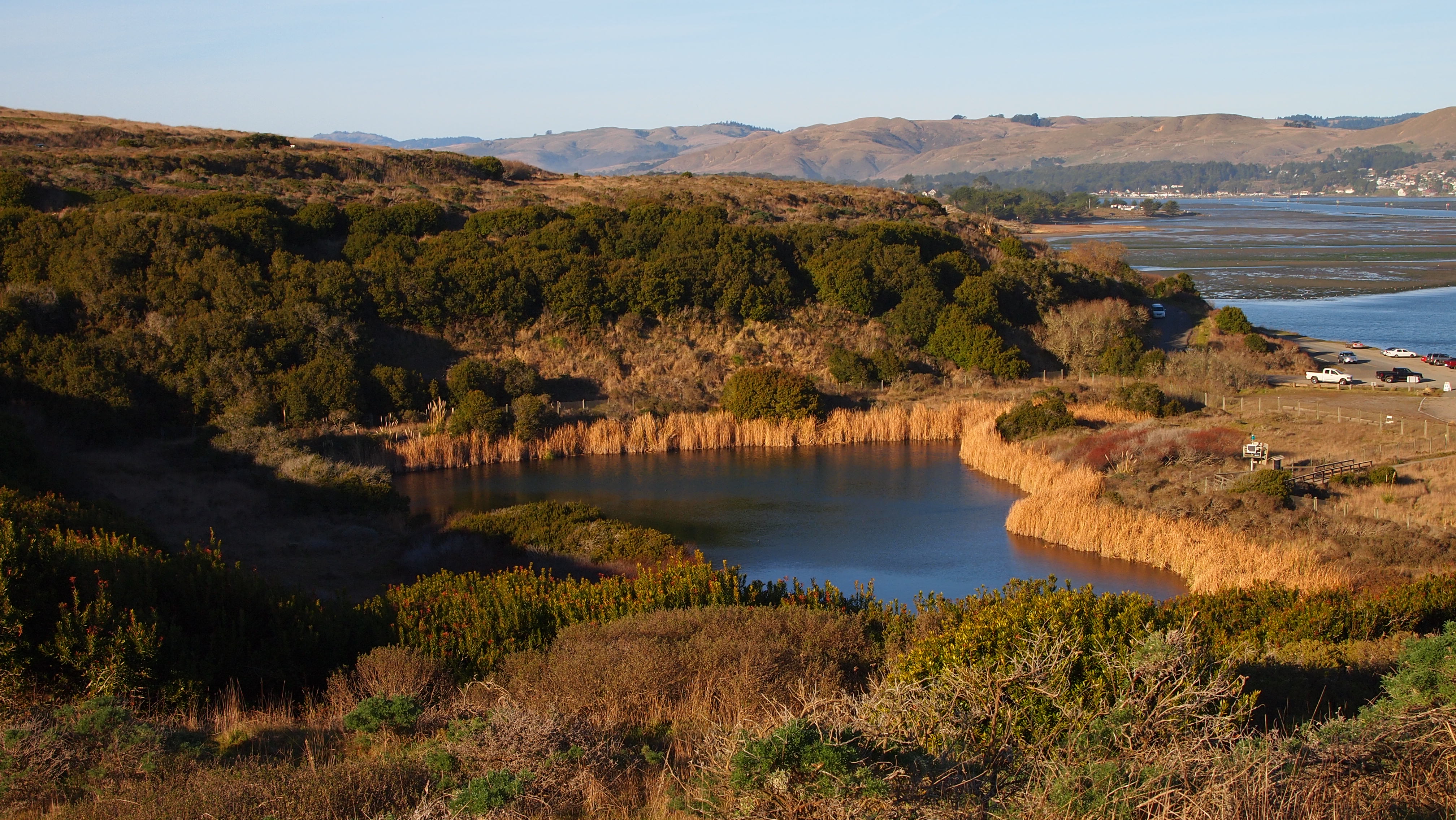
This past weekend we decided to take Lily and Cousteau for a walk around Shollenberger Park on the south end of Petaluma. The park is a 165-acre area with a two-mile trail surrounding wetlands and mudflats. On the north end of the park, another trail juts off toward the marina that goes a mile through a marsh. The park also abuts the Petaluma River, which is a beautiful sight to see. To give you an idea of the flow of things, the river flows downstream to San Pablo Bay, which connects into San Francisco Bay, which connects, of course, to the Pacific Ocean.

Shollenberger is a great place to go for a walk, run, or casual stroll. The whole park is filled with different kinds of birds. There are ducks, geese, swans, vultures, avocets, gulls, doves, plovers, falcons, crows, hummingbirds, and more. And that’s just a list of the commonly seen birds in the wetlands! There is a great list of birds on the Petaluma Wetlands website, the organization that oversees the protection and operation of the park. You can see the list at www.petalumawetlands.org.

As we walked around the trail, I could not help but think that this is exactly the type of park that both provides a healthy place for people to visit and a safe haven for local wildlife. It is a place of balance. People can enjoy the trails and the scenery, and the birds and other creatures can live relatively undisturbed. What a wonderful environment.

We continue to explore wonderful places like this in and around our new stomping grounds. Let the adventures continue!

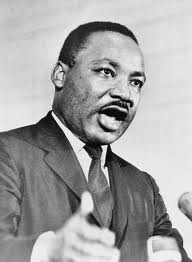
Dr. Martin Luther King, Jr. (1929 – 1968) The Man and his Mission

Martin Luther King was a man of peace, who sought radical transformation.  The power of his
personality and the impact of his words on the civil rights movement cannot be overstated. Dr. King lived in an age when the Ku Klux Klan instilled terror in sections of the South and even into Missouri.  He lived when drinking fountains, schools, buses, housing and employment were highly segregated.  His influence in the civil rights movement extended through the mid 1950’s until his death in 1968.  He changed the national dialogue on issues of race while steadfastly maintaining a commitment to non-violence and the importance of personal integrity.

His famous “I Have a Dream” speech, given August 28, 1963, at the Lincoln Memorial includes these words, “I have a dream that my four little children will one day live in a nation where they will not be judged by the color of their skin but by the content of their character.” It concludes, “Free at last, Free at last, Thank God almighty we are free at last.”

A disciple of Mahatma Gandhi’s message of nonviolence, Dr. King constantly reminded his followers that love is better than hate, that character and integrity are the measure of individuals and society.  Following are some of the quotes that exemplify his message:

Love over hate:

Darkness cannot drive out darkness; only light can do that. Hate cannot drive out hate; only love can do that.”

“I have decided to stick to love…Hate is too great a burden to bear.”

“Let no man pull you so low as to hate him.”

 “Love is the only force capable of transforming an enemy to a friend.”

Non-violence

“Returning violence for violence multiplies violence, adding deeper darkness to a night already devoid of stars.”

 “The choice is not between violence and nonviolence but between nonviolence and nonexistence.”

 “We must live together as brothers or perish together as fools.”

 The Importance of Social Commitment

“Never, never be afraid to do what’s right”

 “The ultimate measure of a man is not where he stands in moments of comfort and convenience, but where he stands at times of challenge and controversy.”

 Injustice anywhere is a threat to justice everywhere.”

The day we see the truth and cease to speak is the day we begin to die.

Due to his accomplishments, Dr. King received Time Magazine’s 1963Man of the Year” award and the 1964 Nobel Peace prize.  In 1983, President Ronald Reagan signed the law making Dr. King’s birthday a holiday.  It has been observed since 1986.

Made in the USA: The importance of buying local

Meg has a J.D. in Urban, Land Use and Environmental Law. She focuses on maintaining the balance of community and environmental health, healthy lifestyles, and encouraging sustainable living.

How much of what you buy is actually made in the USA? My mother and I were discussing this very topic the other day. We both make it a point to buy U.S. made products whenever possible. Obviously, it’s difficult to make sure everything we buy is made here, but if you’re patient, you can find many U.S. made options for almost any product.

“Made in USA” used to be a considered a stamp of quality. You knew that if you bought something made here in the States, it was going to be top quality and last forever. While that may still be the case, unfortunately, people just don’t think about where products are made anymore. As a result, it becomes more and more difficult for corporations to justify the “higher cost of labor” to have products made here and not somewhere else. So where do they go? Where does almost every “Made in…” stamp say? China.

I don’t have anything against China. From what I know, and I only know from what others have told me based on their experiences, China is filled with smart, kind people who care about the world and how to keep things in balance. These are definitely concepts I find valuable. My only problem with China, quite frankly, is that everyone here complains about how frustrated they are that we are dependent on China to keep our economy running. I have no idea how to approach that frustration, but I do know that we can all start by buying local.

There are a lot of products still made in the USA, you just have to make an effort to look for them. It may mean you have to be patient at times, but if we all make an effort to avoid buying products made somewhere else, then we can do our part to support our own economy and our own workers. Personally, I have been looking for a desk to use at home for several months now. Part of the wait was because I didn’t find anything I liked, but also because I wanted to desk I bought to be made here. Sure enough, when Jake and I went to the hardware store this week, there it was. A nice, simple desk made by Sauder Woodworking Company, manufactured in Ohio. It wasn’t even expensive, which is usually a concern people have about buying local. It was perfect.

So with that in mind, I challenge you to buy local. Whether you are looking for clothing, appliances, vegetables; with almost every product, you can find something “Made in USA.” Some products may be more expensive, but not all of them are. Some of them are still considered top quality, like St. John Knits, Levi Jeans, Maytag, KitchenAid, Lenox fine china, Simon Pearce glassware. One of my personal favorites, Harley Davidson, has a major manufacturing center in Kansas City. Ford still makes their vehicles in Detroit. If you just take the time to look at the label before you buy, you really can do your part to support the U.S. economy.

Muir Beach Outlook and Stinson Beach

Meg has a J.D. in Urban, Land Use and Environmental Law. She focuses on maintaining the balance of community and environmental health, healthy lifestyles, and encouraging sustainable living.

As if our Saturday outing to Bodega Head was not adventurous enough, Jake and I decided to add another outing to our weekend. For our Sunday adventure, we went south on 101, cut through Mill Valley and Mt. Tamalpais to Hwy 1, past the Muir Beach outlook, and then on to Stinson Beach. What a way to spend a sunny Sunday afternoon!

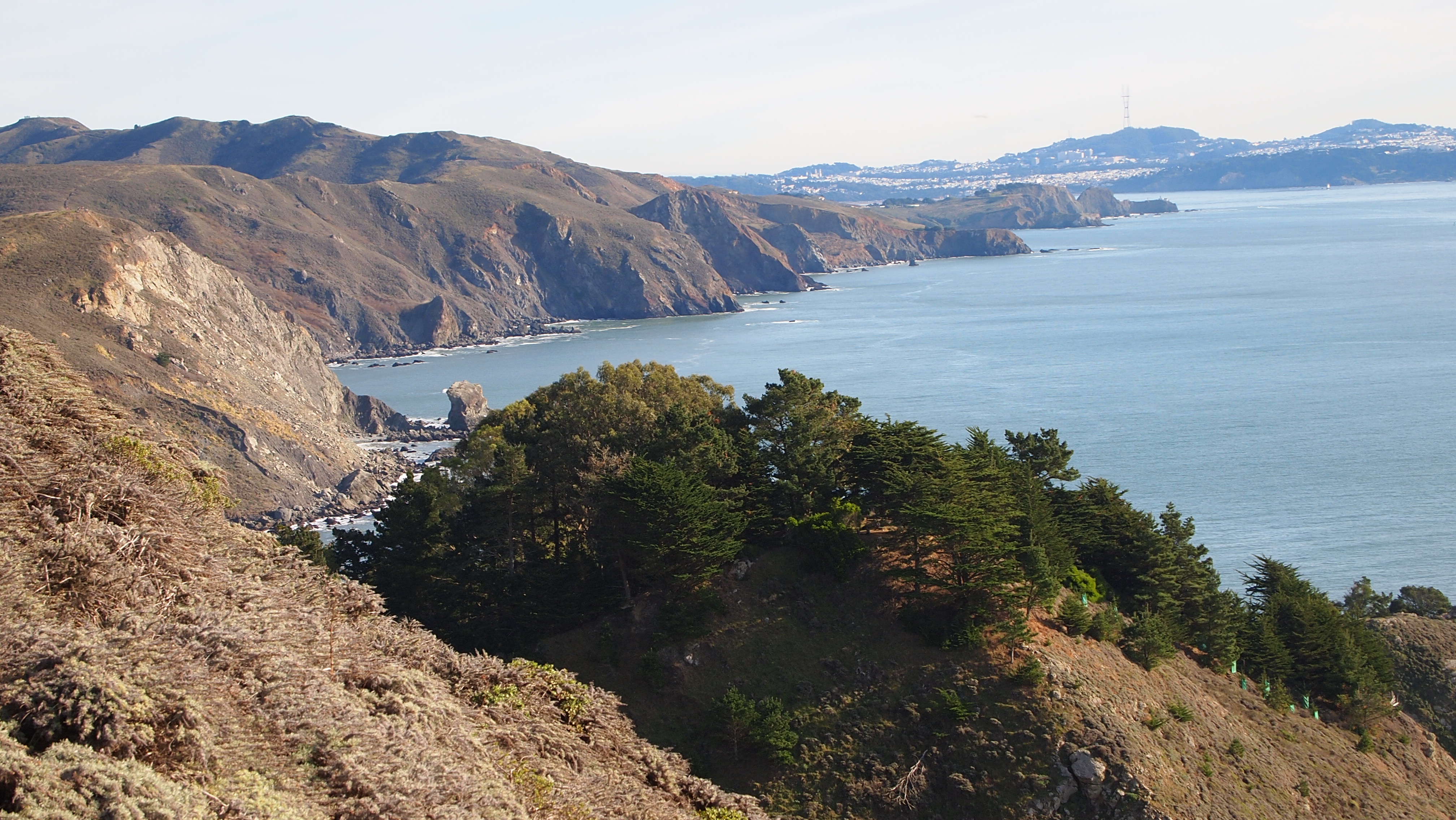
Our first stop along Hwy 1 was the Muir Beach outlook. I can’t remember exactly where the turnoff was, because it was an unplanned stop, but it was up the hill a mile or two from Muir Beach itself. We pulled into the parking lot, which wasn’t too horribly busy, parked the jeep, and walked over to the outlook. It was definitely worth the extra stop! With picnic tables and old military bunkers/lookouts, it doesn’t look like much at first. And then you see it….the magnificent view of the ocean, Muir Beach, the coast to the north, and even the Sunset District of San Francisco. I highly recommend making a pit stop at this place if you’re driving along Hwy 1!

Next, we made our way to our intended destination, the town of Stinson Beach. We decided to have a late lunch at a restaurant called the Sand Dollar. They had the most amazing crab cakes, and by far the best fish tacos I’ve ever had. Messy, but delicious. After lunch, we walked down to the beach and stood staring at the ocean. There were so many people there. Not so much that it felt crowded, just, lived-in. The weather was sunny, mid-60s, and it felt even warmer because we were somehow blocked from the wind.

As we drove north out of Stinson Beach on Hwy 1, we started discussing the different cultures we see just around the bay area. I’ve traveled quite a bit in my life, so I’m no stranger to culture shock, but I’ve never experienced so many different cultural norms in just a few hundred square miles. You have densely packed urban neighborhoods, expansive grazing fields, grape vines, small beach towns with 400 residents… Each pocket has a different experience to offer. And then you drive out of a small town along the highway, look to your left, and see a group of seals hanging out in the water. Of course, we’re not quite used to this yet, so we pulled over and took a picture, but to see all the different environments for both people and animals is quite spectacular.

Another adventure down, and yet another we’ll have to do again. California is just so remarkable, it may take us awhile to see it all.

Hiking Bodega Head

Meg has a J.D. in Urban, Land Use and Environmental Law. She focuses on maintaining the balance of community and environmental health, healthy lifestyles, and encouraging sustainable living.

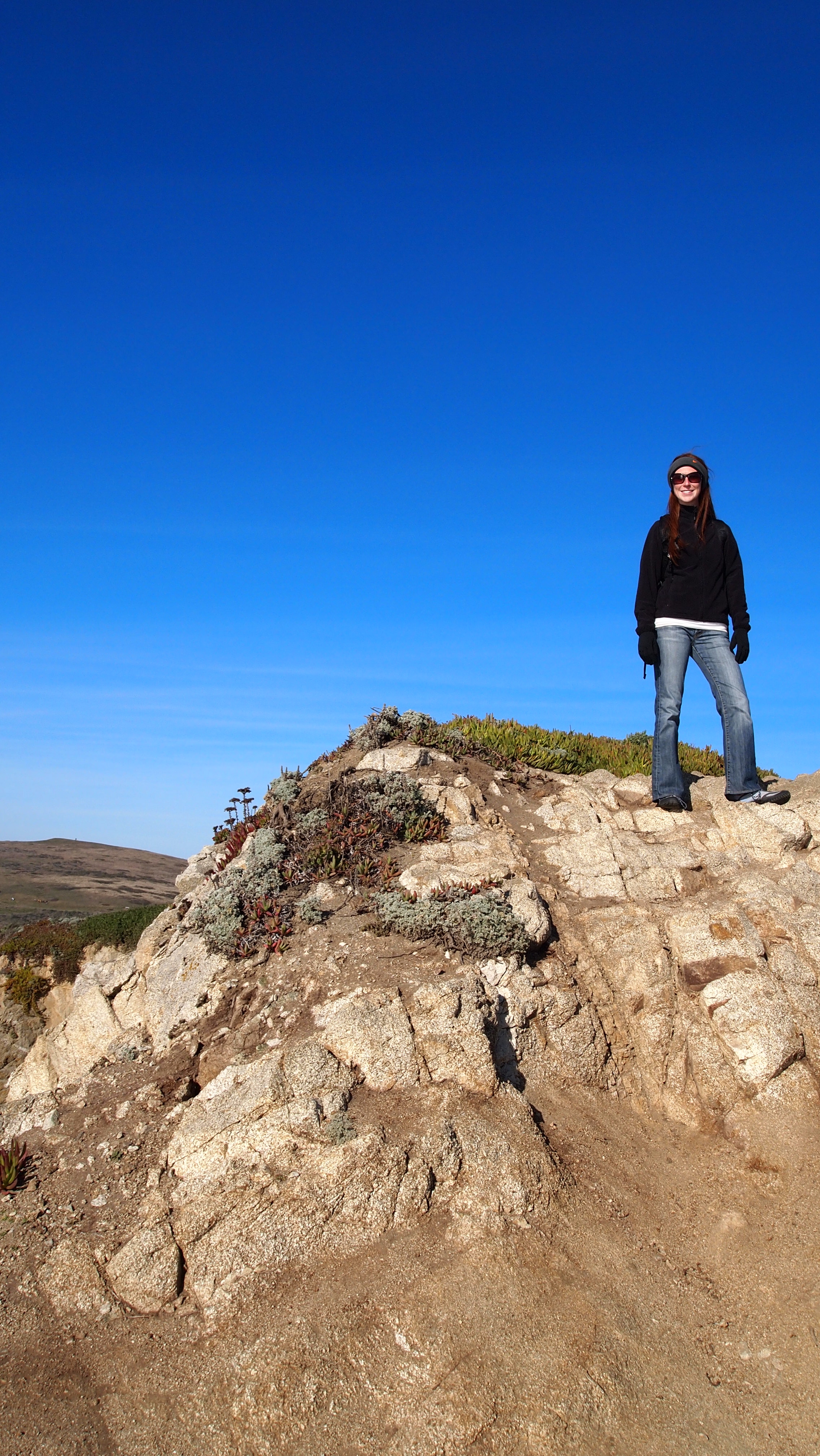
The exploring continues! Yesterday, my husband and I drove out to Bodega Head, a peninsula that juts out into the Pacific Ocean about 30 minutes west of Petaluma. The headlands are a beautiful place to hike around for the afternoon, and even do some whale watching. The hike around the outside loop of Bodega Head is about 2 miles, with an additional mile hike to the north. Of course, if you want to do some serious hiking, you can just keep going along the Sonoma Coast!

Our hike yesterday was lovely. The weather was perfect. 60s and sunny. There was a bit of wind for part of the hike, but overall it was quite nice.

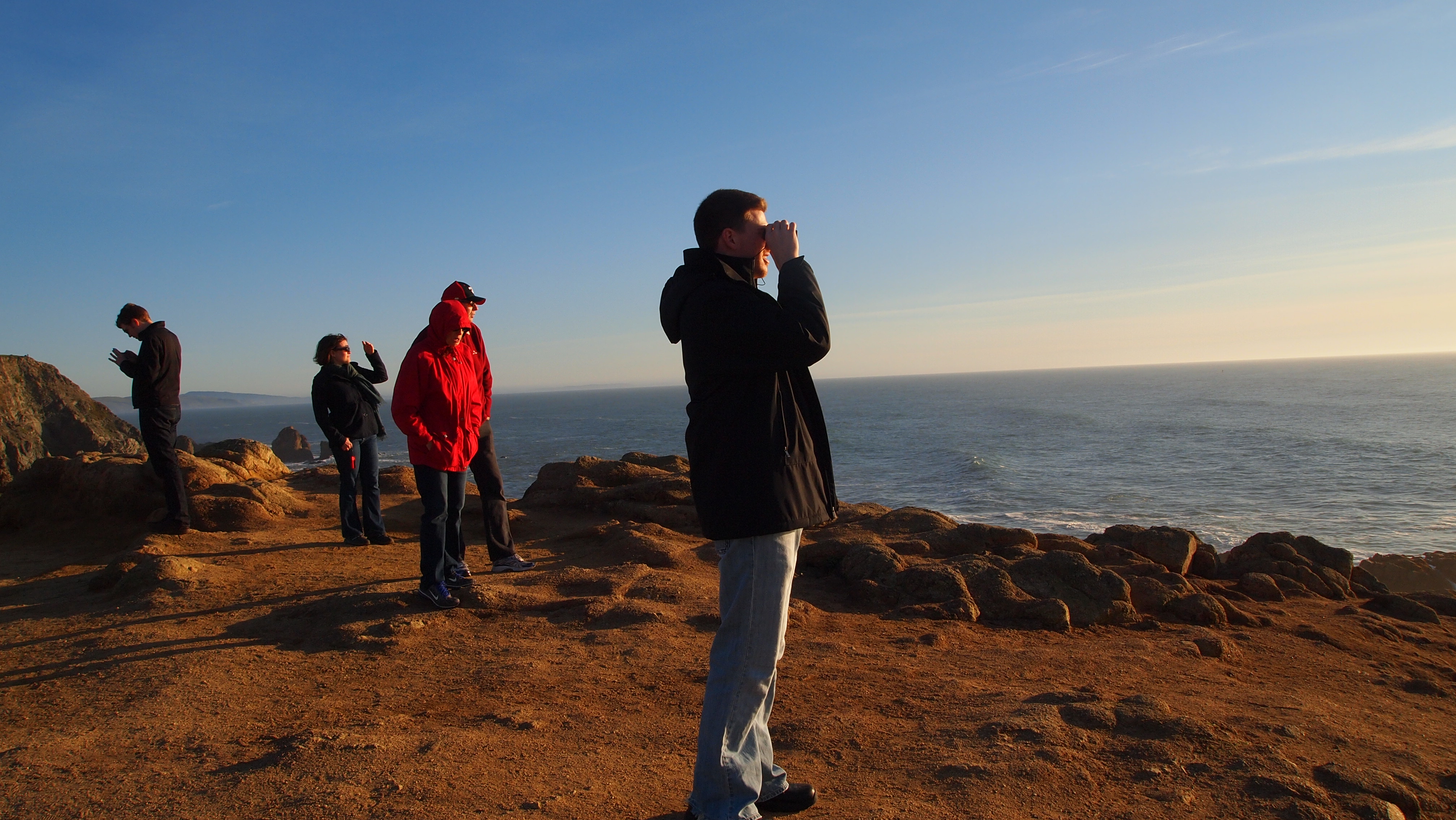
Our first stop was the whale watching point, where local “whale watch” volunteers were waiting to answer any questions and help with whale spotting. We saw a few spouts of water blowing up out of the surface, but did not see any tails. Still, it was an exciting experience.

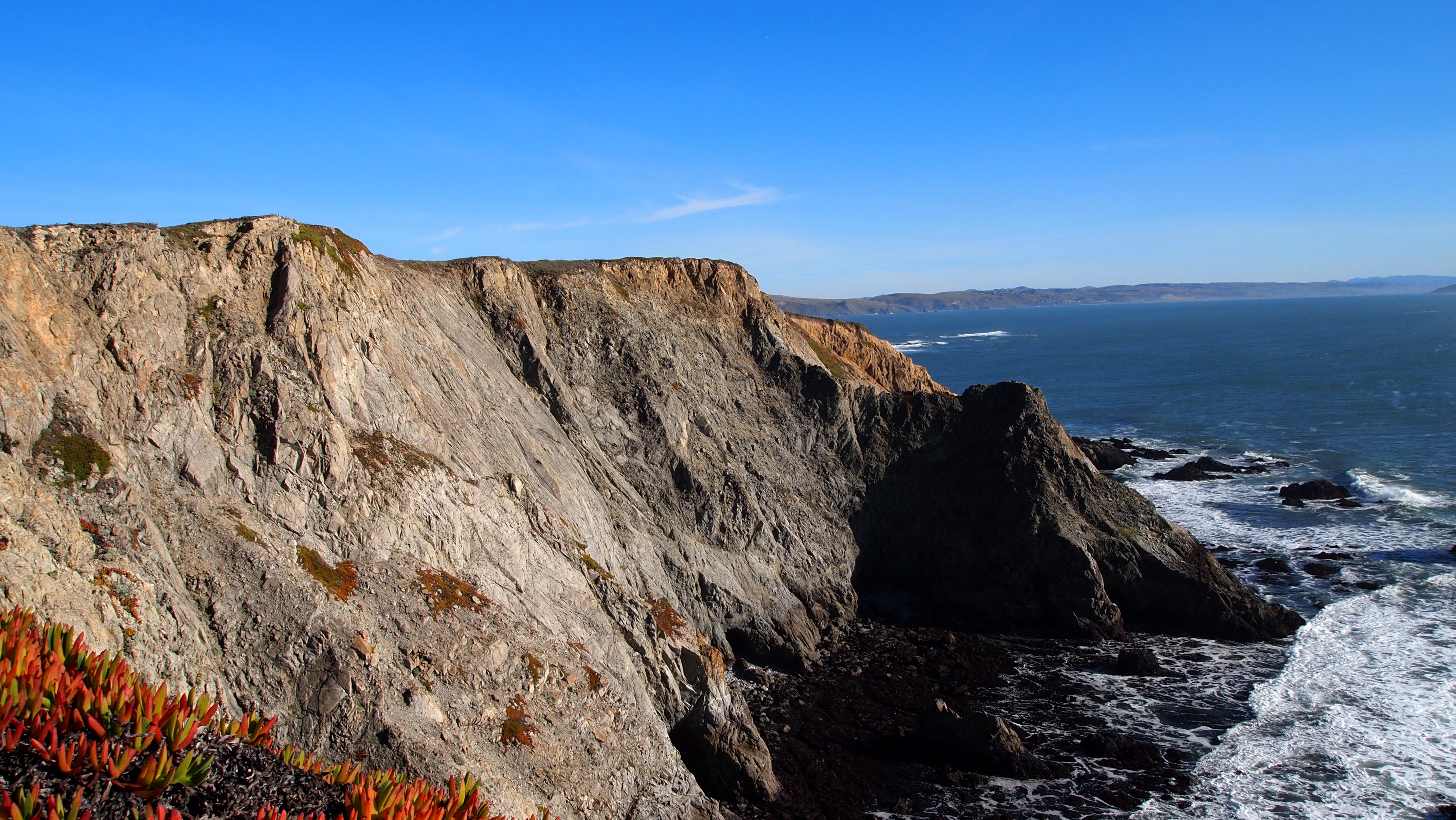
As we continued around Bodega Head, we saw beautiful cliffs, listened to seals and birds in the distance, and saw the “Hole in the Head” dug by PG&E in the 1960s. They had planned to build a nuclear plant on Bodega Head, so they dug a huge hole that would eventually house a nuclear reactor. However, the location of the hole is essentially right on top of the San Andreas fault line, so continuing the project would have been a horrible idea. The hole eventually filled up with rainwater and now serves as a freshwater pond for local wildlife.

Almost at the end of our hike, we had wandered off the beaten path and onto a sparsely used trail. We were still close to the road and the main trail, with the ocean in the background, and what did we see? A family of deer! We must have seen each other at the exact same moment, because right as I jumped up and said “Oh!” (to which Jake immediately thought I had seen something scary, like a snake!), all four deer turned their heads toward us with their ears straight up in the air. All six of us stood perfectly still for at least 30 seconds before any of us moved. As if I thought it would help, I started talking to the deer like I talk to my kids (our greyhounds) when I want them to be calm. Somehow, it worked, and though they wouldn’t let us get close, they did not run away. Eventually, we moved around them, even further off the barely there trail, and they continued grazing nearby. It was beautiful.

Bodega Head is definitely worth visiting. We only hiked about 3 miles, but it you can easily make it longer or shorter depending on where you want to go. Who knows where we’ll venture off to next time!

From Wayside Waifs to Beloved Pet

Meet “Casey Stengel,” aka “Casey,” our family pet. Named for the baseball legend who managed the New York Yankees when I was growing up and Mickey Mantle was a star, the name perfectly suits the dog. Both dog and man are very charming, even charismatic, but not willing to follow anyone’s rules other than their own!

We adopted Casey from Wayside Waifs, a no kill shelter that places over 5000 animals a year in Kansas City homes. It is a wonderful place to visit and the staff and volunteers are very helpful and enthusiastic.

When we adopted Casey in May of 2008, the shelter had just completed a huge adoption event that seemed to have nearly emptied the building. Casey was one of the first animals to be brought into the shelter and I met him in the shelter’s clinic shortly after he had been neutered, vaccinated and treated for heartworm. Needless to say, Casey probably wasn’t feeling his best. Two days later our family came to meet him and took him to our “forever” home.

Casey was scared of everything. He was afraid of the car, the garage, the kitchen, the back yard. He had no idea how to climb stairs. He seemed afraid of grass and was certainly afraid to cross the street. But from the beginning he was gracious and accepting of love and attention.

That was nearly two years ago. He now goes with us everywhere we can take him. He loves our Sunday drives and willingly visits the nursing home where dad lives. He receives lots of attention, which he accepts with grace. I am often asked his breed, because he is a beauty. I’ve also been asked if he is a designer dog, since he obviously has the characteristics of a Tibetan breed. I have finally decided to think of him that way, as a designer dog. Like other mutts, he has unique physical and personality traits that are particularly endearing to me. In that way, at least, he seems to have been designed for us.

If you are looking for a pet, before you go to a pet store, or the classified ads in the paper, how about considering a shelter pet, or a retired greyhound. They need homes; most are wonderful pets and almost without exception will dedicate their lives to giving you unconditional love.

Hiking Muir Woods

Meg has a J.D. in Urban, Land Use and Environmental Law. She focuses on maintaining the balance of community and environmental health, healthy lifestyles, and encouraging sustainable living.

To kick off the new year, I suggested to everyone visiting CA for the holiday weekend that we get out and do something outdoors. I thought a hike through Muir Woods would be the perfect way to get some exercise and do some family bonding. We packed up two carloads of people and drove the windy road through Mill Valley to get to the ocean side of the hills, and in we went to the redwood forest. I do have to give a shout out to Jake and Tio for generously dropping the rest of us at the park entrance. They apparently had to park a mile away, hoof it back and forth for the rest of us, and they didn’t complain once…at least not to “management” (aka, me and Auntie). Thank you gentlemen!

So, for those of you who have never been to Muir Woods, it will be difficult to explain how magical and humbling this forest is. Even with all the other visitors walking through and taking pictures, you almost feel as if you’re stuck in a different time, perhaps even walking through a real life “Lord of the Rings” forest. The forest is filled with redwood trees, which according to the brochure, can grow up to over 300 feet tall. How amazing! The land was donated by the Kent family in the early 1900s as an effort to protect the forest from the booming logging industry. President Roosevelt declared it a national monument in 1908.

Muir Woods was very busy on Sunday, with nearly 50,000 visitors according to the park rangers. Nearby attractions were also very crowded, likely due to the beautiful weather we had in the bay area on New Year’s Day. Even the Alcatraz tours were sold out! Of course, that will be something we do when our little brother comes out to visit us in a few months. Oh, the things to see in California!

When I walk through these amazing places, I am reminded that humans are a fairly new species in the history of the world. Redwood trees, for example, live to be hundreds or even several thousand years old. It is a humbling experience to walk among them, and to realize how close we came to wiping them out in the logging of the early 1900s. It is a reminder that people need to be careful of the resources they abuse and to be cautious of our growing impact on the balance of nature.

The hike was indeed a wonderful way to begin the new year.

Ring in the New Year: Happy 2012!

Meg has a J.D. in Urban, Land Use and Environmental Law. She focuses on maintaining the balance of community and environmental health, healthy lifestyles, and encouraging sustainable living.

What an amazing year! A lot of things happened this past year, and 2011 definitely did not disappoint. We adopted a new handsome greyhound, my husband got a new job, I graduated from law school and passed the bar exam, and we moved to sunny California! All in all, I’d say it was a pretty good year. So naturally, we had to say goodbye to 2011 in style.

Last year we went to a fabulous black tie party in downtown KC with even more fabulous friends. This year, we celebrated in CA with a yummy dinner party at Auntie and Tio’s. After a delicious five-course meal, with each course prepared by a different couple (I made chocolate pots de creme!), we all stayed up until midnight drinking champagne and swapping proposal stories at the table. What a wonderful group of people! Auntie and Tio (the hosts of the evening), Robert and Kathleen (from Roswell, NM), Lina Jane and Bruce (from KC), Janet and Michael (from Manteca, CA), and me and my cute hubby (Petaluma of course!). It was a wonderful evening, and hopefully we can do it again next year.

As we look to the future and what we have planned, it is good to reflect on where we’ve been and what we’ve experienced. This last year was very busy and exhausting, but also very rewarding. I hope 2012 is not quite as stressful, but I look forward to discovering what the new year has in store for me.

Happy New Year everyone. I hope you have a wonderful 2012!

The Federalist Papers and the Judiciary’s Role in Government

In recent election cycles, the courts have taken a bad rap.  They have been identified as elitist, activist, unpopular and even distrusted by the founding fathers.  I reminded myself it had been some time since I’d actually read the Constitution.  I decided to go “to the source” and re-read our nation’s original documents, to address at least one of the above issues, the opinions of the founding fathers about the  judicial system.  I will let the documents speak for themselves:

1)  In declaring independence from England, what complaint is made in the Declaration of Independence, signed July 4, 1776, about the relationship of King George and the judiciary?  “He [King George] has made Judges dependent on his Will alone, for the Tenure of their Offices, and the Amount and Payment of their Salaries.”

2)  How did the Constitution, adopted September 17, 1787, handle the separation of the powers of the legislative, executive and judicial branches of government?  The Constitution divides the powers of  government in separate articles as follows:

“Article I, Sec. 1:  All legislative Powers herein granted shall be vested in a Congress of the United States…

Article II, Sec. 1:  The executive Power shall be vested in a President of the United States of America…

Article III, Sec. 1:  The judicial Power of the United States shall be vested in one supreme Court, and in such inferior Courts as the Congress may from time to time ordain and establish. …”

3)  What are the Federalist Papers and why do we care?  They are a series of 85 essays, originally titled  Federalist: a Collection of Essays Written in Favor of the New Constitutionpublished in 1788 to gain support for the passage of the Constitution. written to promote the ratification of the Constitution.  They have also had a significant impact on U.S. Supreme Court interpretations of the Constitution.
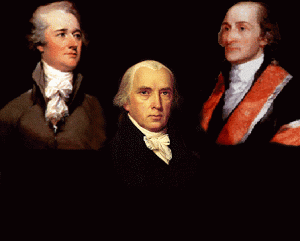
4)  Who authored the Federalist Papers?  Alexander Hamilton, James Madison and John Jay.  Among other roles in the founding of the United States, Alexander Hamilton served as a New York delegate to the Constitutional Convention; James Madison was the fourth President of the United States, was instrumental in drafting the Constitution and was the author of the Bill of Rights; John Jay was the first Chief Justice of the United States.

5)  Do the Federalist Papers address the role of the judiciary and the separation of powers?  Yes.   Federalist # 78 focuses on the relationship between and among the branches of government and the role of the judiciary as it relates to the interpretation of the Constitution.

6)  Why did the Constitution provide for a separation of powers among the three branches of government?   In the Federalist Papers, Alexander Hamilton explains …”there is no liberty, if the power of judging be not separated from the legislative and executive powers.” “The complete independence of the courts of justice is clearly essential in a limited Constitution…. [the courts have the duty] to declare all acts contrary to the manifest tenor of the Constitution void. Without this, all the reservations of particular rights or privileges would amount to nothing.

6)  Do the Federalist Papers describe the role of the judiciary in interpreting the Constitution?  Yes.  Federalist #78 explains that the “interpretation of the laws is the proper and peculiar province of the courts. A constitution is, in fact, and must be regarded by the judges, as a fundamental law. It therefore belongs to them to ascertain its meaning, as well as the meaning of any particular act proceeding from the legislative body. If there should happen to be an irreconcilable variance between the two, that which has the superior obligation and validity ought, of course, to be preferred; or, in other words, the Constitution ought to be preferred to the statute, the intention of the people to the intention of their agents.”  “…under the Constitution, the federal courts would have not just the power, but the duty, to examine the constitutionality of statutes.”

7)  Do the Federalist Papers express a distrust for the judicial branch?  No.  While the Federalist #78 acknowledges that “though individual oppression may now and then proceed from the courts of justice, the general liberty of the people can never be endangered from that quarter; I mean so long as the judiciary remains truly distinct from both the legislature and the Executive.”

 8)  Why did the Federalist #78 describe the judicial branch of government as the weakest of the three branches?  The Executive branch not only “dispenses the honors, but holds the sword of the community.”  The legislature “commands the purse”.  The judiciary “has no influence over either the sword or the purse; no direction either of the strength or of the wealth of the society…”

9)  What is the purpose of the provision in  Article III, Sec. 1 of the Constitution that Judges “shall hold their Offices during good Behaviour [essentially lifetime appointments]?  The Federalist Papers #78 explains that: “from the natural feebleness of the judiciary, it is in continual jeopardy of being overpowered, awed, or influenced by its co-ordinate branches; and that as nothing can contribute so much to its firmness and independence as permanency in office, this quality may therefore be justly regarded as an indispensable ingredient in its constitution, and, in a great measure, as the citadel of the public justice and the public security.

10)  Did the founding fathers consider one branch of government to be superior to others?  No.  The Constitution was written to put the interests of the people, not the interests of government, first. The colonies declared their independence from England because of the tyranny of King George.  The separation and balance of powers is for the protection of people, rather than for some other purpose.  Federalist Papers #78 is clear that the Constitution does not  “suppose a superiority of the judicial to the legislative power. It only supposes that the power of the people is superior to both; and that where the will of the legislature, declared in its statutes, stands in opposition to that of the people, declared in the Constitution, the judges ought to be governed by the latter rather than the former. They ought to regulate their decisions by the fundamental laws, rather than by those which are not fundamental. Further, it is far more rational to suppose, that the courts were designed to be an intermediate body between the people and the legislature, in order, among other things, to keep the latter within the limits assigned to their authority.

11)  What other essays included in the Federalist Papers are of significance in determining the view of the founding fathers concerning the role of the judiciary?  Essay #1 describes the goal of the Constitution as focused on “whether societies of men are really capable or not of establishing good government from reflection and choice.” He and his co-authors along with other leaders including George Washington, believed that the Constitution represented a unique and important change in, and improvement over, prior forms of government.  Essays 4 and 33 deal with the Supremacy Clause set forth in Article V of the Constitution, but those are matters for another day!

Why haven’t I addressed the other issues raised concerning perceived flaws in the judiciary and individual judges?  It is reasonable to believe that people of good will can have differing opinions about individual judges, individual decisions and frailties in any arm of government.  I have no desire to enter that debate.  The humanity and imperfections of each of us individually and collectively are not up for debate.  But what I think is important to recognize is that the Constitutional framework was designed to include a separation of powers of the three arms of government because the founding fathers believed that it was in the best interests of the people to do so. The courts were not considered inferior or superior to the other branches of government.  The courts were, however, considered essential to the creation and fulfillment of our system of Democracy.
Happy Holidays from Shifting the Balance

Merry Christmas!

It is a wonderful time of year. We may not have snow in Kansas City, but holiday spirit abounds, and the joy of Christmas is in the air. After all the hustle and bustle getting ready for today, everything’s is now quiet. It has been a day of family, great food, and lots of laughter.

Now that the sun is nearly set on this beautiful day, we are settling in, building a warm fire and pouring a glass of wine. We hope you and your family have a Merry Christmas, a Happy Hanukkah and a joyous New Year.

Meg and Ann