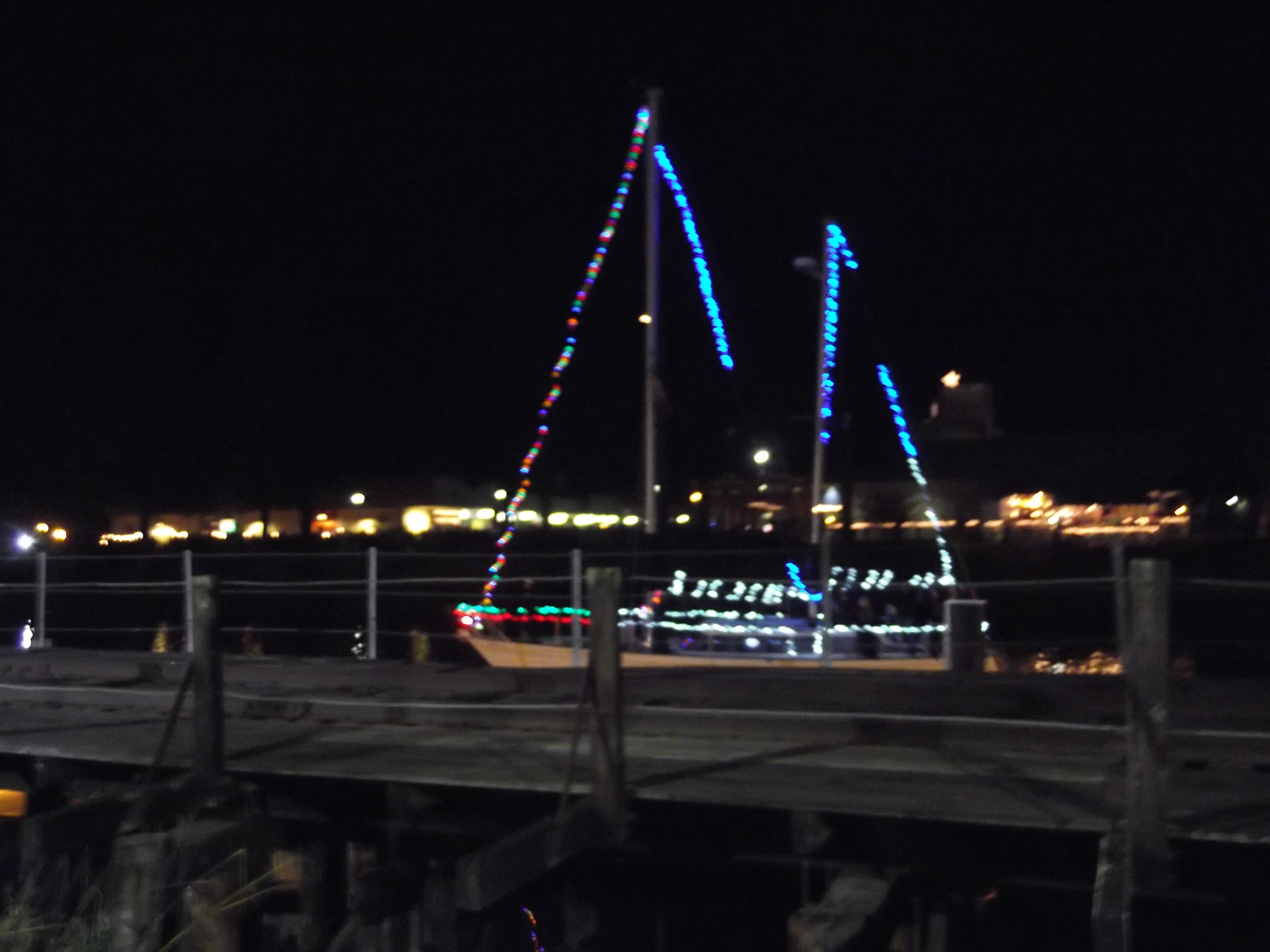
Petaluma City of Lights – Driving Tour 2011

Meg has a J.D. in Urban, Land Use and Environmental Law. She focuses on maintaining the balance of community and environmental health, healthy lifestyles, and encouraging sustainable living.

The holidays are fast approaching, and one thing I have missed about Kansas City is the cold weather and snow reminding you it is almost time for Christmas. Well, Petaluma may be in the mid-50s this time of year, but the nights are still very chilly, and this town sure does know how to put on a holiday display! One of the local papers puts out a driving map every year of the entrants for the holiday decorating contest. This year there are 16 resident entrants and 47 business entrants.

On Monday evening, Jake and I packed the kids (our greyhounds) up in the jeep, grabbed the 2011 driving tour map and some hot chocolate, and headed out the door. We spent almost 2 hours driving around looking at all the houses, and we didn’t even get to the business entrants! For every official resident entrant, there must have been 3-4 houses that did not enter the contest. They were all amazing. Some yards had nativity scenes, some had entire towns of snow people. One yard down the street had a whole ensemble of Acme characters dressed up for the holidays, and they were 4-5 feet tall!

The last place we visited was by far the most impressive. Courtesy of the Barnacle family, this house was filled with moving reindeer, a christmas tree, hundreds of lights, a full nativity scene, an entire mini Christmas town, and a flying Santa. Unbelievable! The mini town they built in their window was amazing. It even appears they secured a radio frequency to play a particular Christmas song to go along with their theme.

It was a wonderful way to get in the holiday spirit. Even the kids were having fun sticking their heads out the window and saying hello to all the people doing the same tour. We may not have snow in California, but we still manage to have amazing holiday spirit!

The Constitution and the Courts: Marbury vs. Madison

I bet you didn’t wake up this morning thinking about U.S. Supreme Court decisions or even about the U.S. Constitution itself. Occasionally, though, it is good to reflect on the principles of our Democracy.  That brings me to Marbury vs. Madison.

The U.S. Constitution was signed in 1787.  Just 16 years later, in 1803, Chief Judge John Marshall authored the landmark decision of Marbury vs. Madison. In that decision, the Court for the first time declared a statute unconstitutional. The decision itself limited the Court’s power, finding powers granted to the Court in the Judiciary Act of 1801, to be beyond the powers included in Article III of the Constitution.  Article III provides in pertinent part:

Section 1:  The Judicial Power of the United States shall be vested in one supreme Court and in such inferior Courts as the Congress may from time to time ordain and establish. . .

Section 2.  The judicial Power shall extend to all Cases . . . arising under this Constitution, the Laws of the United States, and Treaties made, or which shall be made. . .

The Court explained it’s decision as follows: “the particular phraseology of the constitution of the United States confirms and strengthens the principle, supposed to be essential to all written constitutions, that a law repugnant to the constitution is void; and that courts, as well as other departments, are bound by that instrument”.

The Supreme Court’s exercise of the power of Judicial review of statutory law is in sharp contrast to the British laws. The importance of such review was discussed by the founding fathers during the drafting of the Constitution.  Alexander Hamilton, whose writings  are seen as an important source for Constitutional interpretations, wrote in The Federalist #78, published in 1788, “there is no liberty, if the power of judging be not separated from the legislative and executive powers.”

No case authority or Constitutional Amendment has reversed this important decision placing on the Supreme Court the responsibility to review laws enacted by federal and state legislatures for the purpose of determining whether such legislation is consistent with the Constitution.  Marbury vs. Madison remains the law of the land.

Searching for a Cause

Meg has a J.D. in Urban, Land Use and Environmental Law. She focuses on maintaining the balance of community and environmental health, healthy lifestyles, and encouraging sustainable living.

I am absolutely amazed at the different ways you can “give” to charities nowadays. Many people think the only way to be charitable is to donate money to a cause. While this is clearly an important piece of giving to charity, it is not the only way to help support your favorite cause or organization. My family has always been a giving family. My mother helps advise organizations, my uncle helps organizations create strategies, and my grandfather often writes a check to organizations he believes are in great need of financial support. I choose to donate my time. As a recent graduate, it’s certainly more affordable, but it also makes me feel like I’m an active part of supporting my favorite cause.

A few years ago, my husband and I adopted a “retired” greyhound. Our Lily has become such a joy, and she inspired us to volunteer with the local greyhound rescue group in Kansas City, called “REGAP” (Retired Greyhounds As Pets). After volunteering for a few Meet & Greets on the weekends, we then started fostering. Finally, with our 4th foster, we “foster failed,” which means we couldn’t let the little spaz go. Now Cousteau has been with our family for almost a year.

So this all brings me to the point of my title today, “Searching for a Cause.” KC REGAP found this great website where you can do web searches (sort of like Google), shop online, and locate restaurants. Meanwhile, every time you search or shop, you earn money for your designated cause! For example, if I want to search “restaurants in Petaluma,” I simply type it into the search box, click search, and I immediately earn a penny for REGAP just for clicking the search button! I know it doesn’t sound like a lot, but imagine how many times you do a web search in a day. Well, if you search 20 times a day, then you can earn $.20 every day for your cause. The shopping section also links you to stores who will donate a certain percent of your total purchase. Such stores include Apple, Amazon, Banana Republic, Nordstrom, and many more. Plus, they have a whole bunch of coupons. It’s really such a great idea for raising money! Here is a link to their site, so you can take a look at it and see if your favorite charity is signed up.


GoodSearch: You Search...We Give!

Happy searching!

Congratulations, Kansas City

Frommer’s, publisher of travel guides, lists Kansas City as one of the top ten travel destinations for 2012.  Others selected include such exotic locations as Bay of Fundy, Nova Scotia, Ghana and Chongqoing, China.

While neither exotic nor remote, Kansas City was selected based primarily on its ever expanding emphasis on arts and culture.  Frommers focuses on the recent completion of the Kauffman Center for the Performing Arts (described as one of the most technically advanced performance halls in the U.S.), the new
contemporary wing of the Nelson-Adkins Art Gallery; and the Kemper Museum of Contemporary Art.  It also identifies the College Basketball Experience interactive facility adjacent to the Sprint Center, the Negro League Baseball Museum and the Kansas City Jazz Museum that share space at 18th and Vine.  In addition to raving about these and other attractions, the article raves about Kansas City barbecue.

Those of us who live here, love Kansas City already and easily brag about our attractions.  It is nice to know that now a world-class expert on travel recognizes our city as a world-class destination.

Protests Then and Now–Protests of the 60s, about Peace and Love?

The protests of the 1960s, which continued into the mid-1970s focused on two issues: the unpopular war in Vietnam and the civil rights movements.  The purposes of the protests were clearly articulated and very specific.  Protesters opposed the draft, the war and inequality based on race, sex and class.

The protestors were often college students and young professionals.  They attended class, took exams, held responsible jobs.  On weekends and after hours they demonstrated.  While there were glaring exceptions to the norm, most protests were peaceful and most protesters went home to their own beds at night.  Despite being unpopular among parents, the police, and many educational and government officials, the response to these protests was generally reserved.

The deaths of 4 students at Kent State, May 4, 1970, at the hands of the National Guard, was perhaps the most tragic event associated with the peace movement.  The deaths of 4 African-American children in the Atlanta church, Sept. 15, 1963; the lynching of 3 civil rights workers involved in voter registration in Mississippi; involved in voter registration June 21, 1964; and the assassination of Martin Luther King, in Tennessee, April 4 1968, are the most often remembered deaths of the Civil Rights movement, but they do not stand alone.

Most demonstrations were peaceful.  Protesters marched, congregated in parks, on university campuses, and occasionally near military bases and government buildings.  They lit candles and bonded together.  They attended rock concerts like Woodstock and Cornstalk[1] where much of the music focused on peace, equality and empowerment.   But as much as memories of those who participated in those protests focus on commitment to love, peace, music and equality, some protesters turned violent.  Splinter groups, including the Weathermen, a faction of Students for a Democratic Society, developed radical agendas, called for violent revolution, became involved in criminal activities, took over university buildings and bombed banks and government buildings.

The Paris Peace Accords of 1973 ended U.S. military involvement in Vietnam.  All U.S. soldiers left Vietnam by 1975.  College campus calmed and the peace demonstrations came to an end.  The civil rights movement was transformed from protest marches to structured organizations over a period of time.  Cool heads would differ as to whether the protests caused the integration of schools, buses, restaurants, with the passage and enforcement of legislation.  However, there is no doubt that key legislation occurred almost simultaneously with the protests, including the passage and enforcement of laws such as Equal Employment Opportunity Act of 1964 as amended in 1972, which prohibits discrimination on the basis of race, color, religion, sex and national origin; and Title IX, which prohibits discrimination in education on the basis of sex.

It was a time of love and hate, peace and violence, equality and class/racial struggles; but the times they were a changing!


[1] Seriously, Cornstalk was a big event in rural Kansas.

Handel’s Messiah “Hallelujah”

Listening to the Messiah is like being in church. It is, as it should be, a celebration of a religious faith, but also it is a celebration of life, the beauty of life, and the power of the human spirit.

The Independence Messiah Choir has performed for nearly 100 years. Recently it became associated with the Kansas City Symphony. This year they move to Kauffman Center for Performing Arts. The combination of the music and the beauty of Kauffman are near perfection.

Messiah is important to our family. Dad emceed the 50th performance, my brother, Bob and his wife became engaged during the Hallelujah Chorus, and Meg sang with the Choir for 4 years before moving to California. This year dad and I watched and listened to the music of the Messiah and were awed, one more time, by the performance and the brilliance of Handel.

Kansas City Lights–Light up the Holiday Season


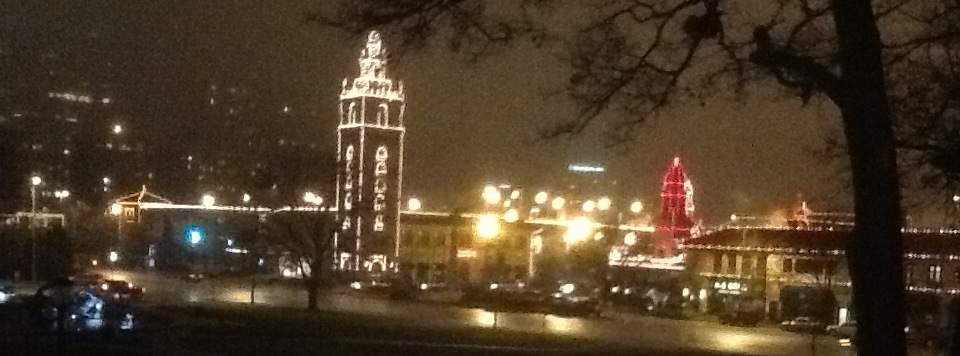
Every city celebrates the holidays differently. For Kansas City, the Christmas season “officially” begins when the Plaza lights are turned on Thanksgiving night. The crowds pack the Plaza for the ceremony to switch on the lights. Traffic backs up for blocks around waiting for their chance to see the lights. I do not remember a time when my family did not make at least one trip to see the lights. Now I live only blocks away and can see them every night as I drive home from work.

There are other lovely holiday displays. Nativity scenes remind us of the religious focus of Christmas, houses and neighborhood shopping areas decorated with lights, wreaths, community Christmas trees and other holiday displays remind us that the season is also shared with other religious and non-religious groups who celebrate their own religious traditions and simply celebrate the joy of the season.

Have a happy holiday, wherever you are.

Petaluma’s Lighted Boats

Meg has a J.D. in Urban, Land Use and Environmental Law. She focuses on maintaining the balance of community and environmental health, healthy lifestyles, and encouraging sustainable living.

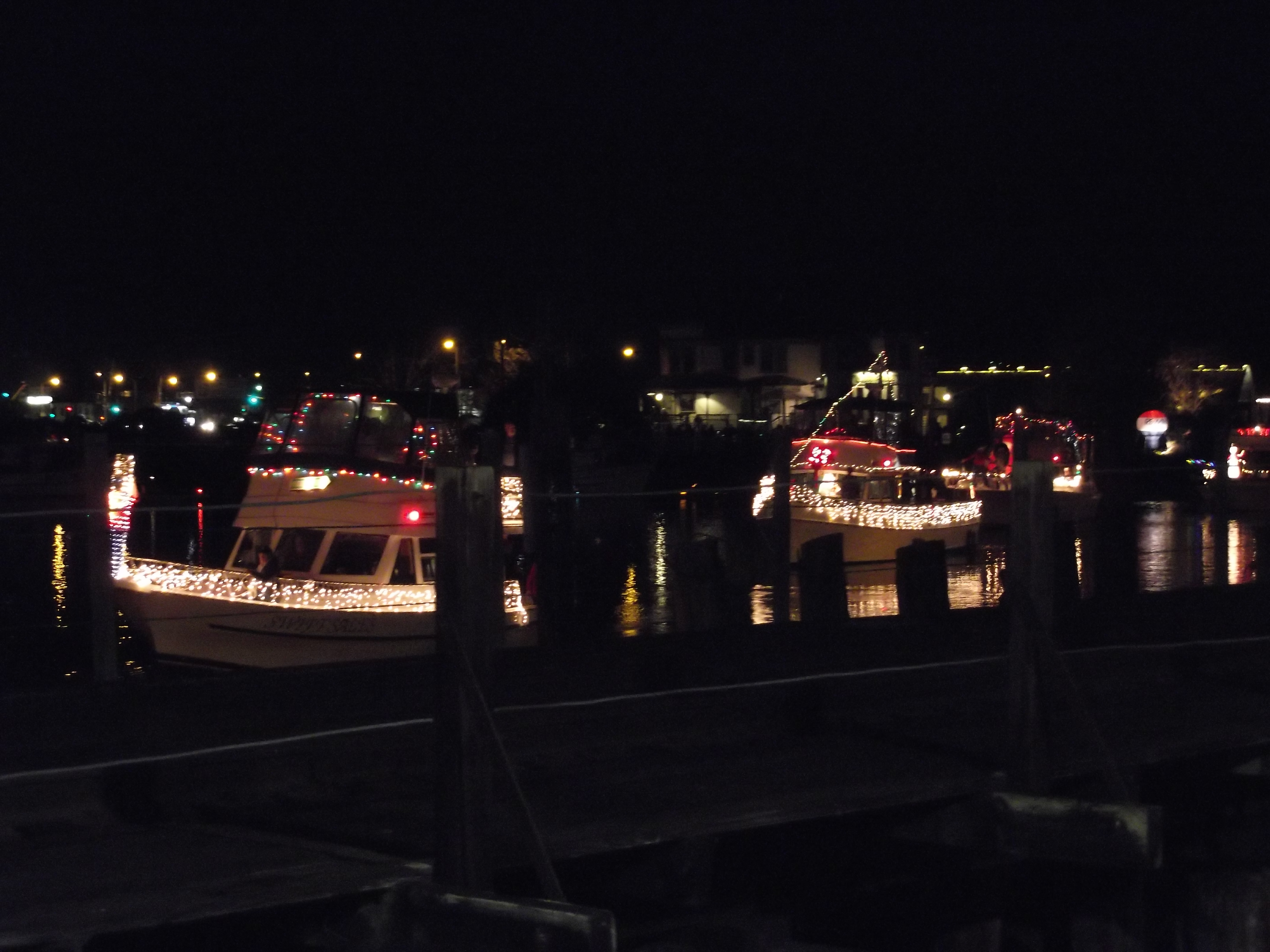
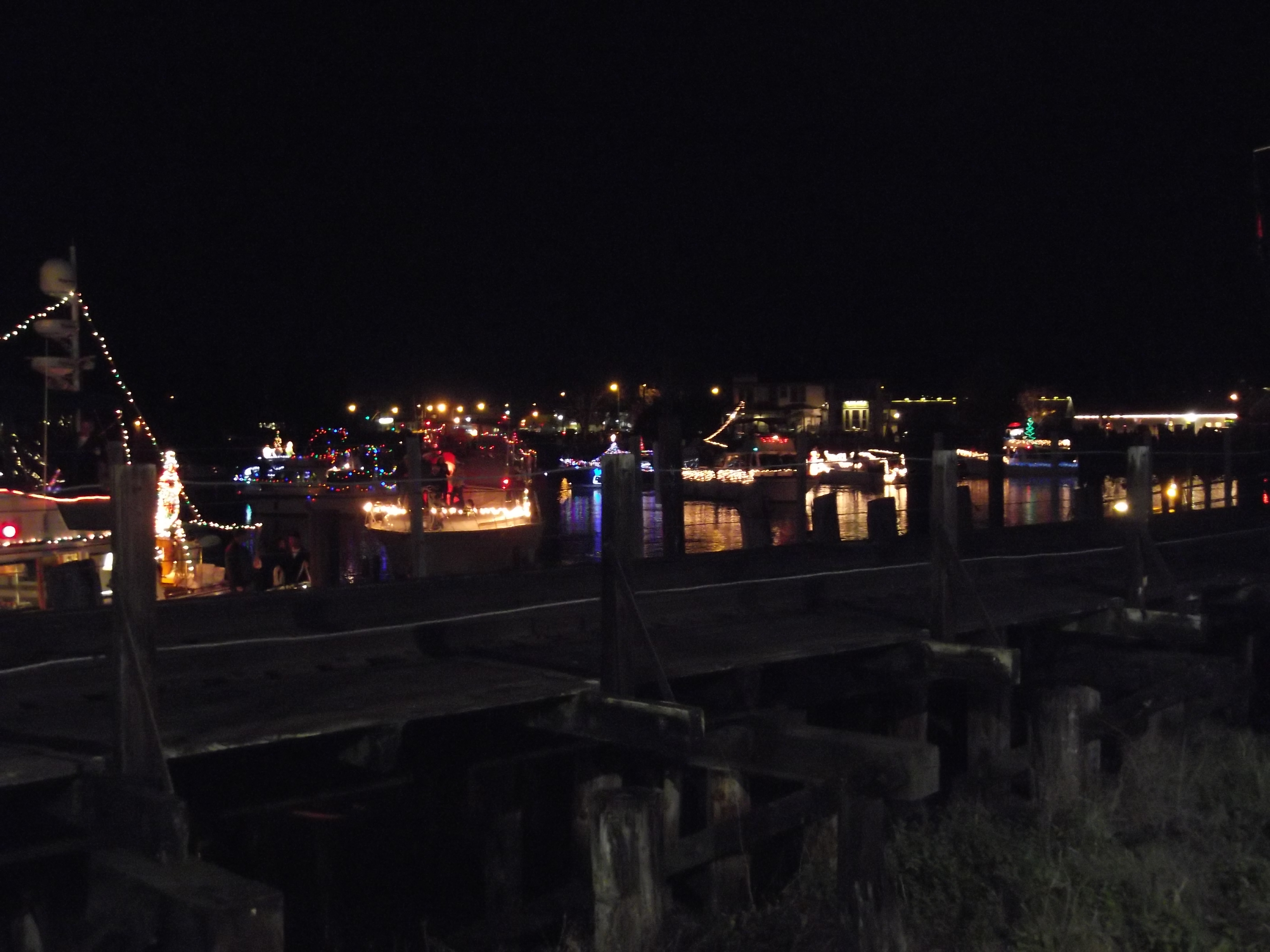
As new locals to Petaluma, my husband and I have been trying to explore as much of our new surroundings as possible. It is truly an amazing experience to move from Kansas City to California, and every weekend we find something new and fun to “research.” Sometimes it’s a vineyard in the wine country, or a beach in Point Reyes National Park. This past weekend we decided to explore Petaluma’s “old town” (downtown), where we watched to annual Petaluma Lighted Boats on the river.

The boats were supposed to come up the river and into the turning basin (which is basically located in the middle of downtown) around 6:00 or 6:30pm on Saturday. We thought we would go downtown around 5:00pm, walk around a little bit, visit my new favorite furniture store, Roe & Co., and then wander over to the river walk to see the boats. Little did we know, it was going to be packed! We barely found a parking spot, and when we made our way to the river walk, we were fighting for a space to actually see the river. There must have been several thousand people wandering around. It was amazing!

Our next adventure will be to take the driving tour of Petaluma’s Lighted Houses and Businesses. I have to say, for a community without snow, Petaluma sure knows how to reign in the holiday spirit. It’s a wonderful place to be for our first Christmas season away from our hometown.

The Challenge of Illegal Drugs

Meeting the Challenge of Illegal Drugs

Planes, trains and automobiles. What about submarines, buses and cargo ships? Drugs enter the United States through all these forms of transportation. Revenues from illegal drugs worldwide are estimated at $300 billion dollars. In the United States alone, estimated revenues totally $60 billion dollars. This is 13 billion dollars more than the budget of Michigan and 23 billion dollars more than the combined budgets of Kansas and Missouri. The wealth attributed to individual dealers is staggering; one Britain convicted of multiple drug related crimes, is reported to be worth $300 million dollars. He started life as a bouncer!

When my generation thinks of drugs, too many remember the comparatively easy summers of the 60’s and 70’s. If PCP, methamphetamine and cocaine were around, I never heard about it. Marijuana, the drug of choice on many college campuses, could be found in a farmer’s field or purchased from a college classmate. The hippie generation joked about twinkies, grew up, found jobs, raised families and seemed to leave drugs behind.

Fast forward 40 years. The issue of illegal drugs is serious business and we need to be serious about how we respond. The economics of dealing drugs at the local level are discussed by Steven D. Levitt and Stephen J. Dubner, in their book, Freakonomics, chapter 3, Why Do Drug Dealers Still Live with their Moms?The authorsstudiedstreet dealers, ie. “foot soldiers” and concluded that most live at home because their average earnings are below minimum wage for jobs in which the chances of being killed are 1 in 4 . Contrast that to vast sums of money are controlled by international cartels that receive the real profits from drugs. Where does that money go and how is it spent?

A very rough estimate is that annually $10 billion to $30 billion dollars is smuggled South of the border. That money is used to pay those who harvest and/or manufacture drugs; to pay those who transport and sell drugs; to bribes government officials, lavish lifestyles for the drug lords, and terrorism. Terrorism in narrower sense involves funding drug traffickers/terrorists in Afghanistan and throughout that region; terrorism in the broader sense includes the destruction of whole communities in the border towns of Mexico, as well as the violence in the drug communities of our cities.

Drug sales and use sap the life out of our communities, primarily in some neighborhoods within our inner cities. The slogan “an unarmed drug dealer is a dead drug dealer” is more than a slogan. Those engaged in the drug trade too often protect themselves, their drugs and their money with violence, placing themselves, their neighbors and their families at risk of injury or death. The fear of violence and the risk that children will become involved in the drug trade further traumatizes some communities. Inner city street dealers are, in this and all regards, both victims and perpetrators.

So, the question is, what do we do about it? I haven’t a clue. But in the next months I hope to focus my research on various related issues in the hope that I will at least gain a better understanding. I will let you know what I learn.

Dewey’s “Public” and Its Many Problems

Meg has a J.D. in Urban, Land Use and Environmental Law. She focuses on maintaining the balance of community and environmental health, healthy lifestyles, and encouraging sustainable living.

During one of my MPA classes, Politics of Administration, we read a book about the concept of “the public,” how it is formed, and how it is identified.

Review of “The Public and Its Problems”:

In his book “The Public and Its Problems,” John Dewey discusses the concept of “the public” and how its role fits into the history and context of U.S. politics. The reader also uncovers a nexus described between the state, the public and democracy. Dewey describes the problematic nature of the concept of “the public.” After exploring the nexus described by Dewey and the problems with “the public,” I will then explore the most problematic feature of “the public” as it pertains to discussions today, and whether or not the 80 year-old discussion is relevant to political life in the U.S. in 2010.

Throughout the text, Dewey describes a nexus between the state, the public and democracy. These three concepts are intertwined into a system where each depends on the existence of the other. However, part of the difficulty in understanding the significance and meaning of each is knowing how to fit them together in context.

Let us start by trying to understand the concept of “the public.” Dewey says the public exists when the consequences of a conversation or exchange extend outside of the confines of those directly involved in the exchange to affect the lives and welfare of others (Dewey 13). Almost simultaneously with the emergence of “the public” is the emergence of “the state,” which is an entity that involves members of the public bound by shared concerns and interests (33). The state is something to which members of the public belong and identify. However, Dewey does warn that people looking for “the state” will inevitably get lost in the process. It is a concept that is nearly as abstract as “the public” because its existence depends on consequences and the emergence of people who need to be taken care of as a result of those consequences (27).

With the emergence of such entities as the public and the state, a form of government is necessary to govern and administer the needs and concerns of the public. Dewey portrays democracy as a system of government that resulted from fear (86), and a democratic government gave people the ability to participate in their own governing. Within this democratic system, individuals felt free to express their own individualized ideals. Dewey notes that the American Revolution was a revolt against an established government that oppressed individuality (87), and democracy resulted in the U.S. as a form of government administered by the people. Individualism became the new movement within the system of democracy that allowed people to express their own political and social ideals while being involved in the forming of a new political nation.

The nexus of these three concepts converges in their dependence on the existence of each other, but putting them into context is difficult when their boundaries are ambiguous. The public and the state emerge when private exchanges result in external consequences. Democracy is a form of governing the members of the public included in the state, by involving individuals from the public as officials to govern the matters of the public. The challenge arises with the concept of individualism because it inherently discourages unity, a necessary characteristic of a state. Therefore, the development of states must be an ongoing process of experimenting through trial and error, using historical experiences to learn from previous mistakes (33-4).

Dewey sees the public as being problematic mostly because it is difficult to find in the context of a situation. It is an abstract concept to describe an abstract group of people, which makes it difficult to identify. In theory, the public is a community as a whole that is affected by the transactions of private individuals (88), but in practice, it is often very difficult to identify the specific public (and therefore state) affected because of the private nature of the exchanges.

According to Dewey, the difficulty in finding the public lies in the advent of modern technology that impaired the need for face-to-face relationships between members of the public. The very same technologies that create the ease of national interaction also create the ability for individuals to focus on the bettering of their own lives without much personal contact with others (131). The individualistic philosophy utilizing the new technology is a force that detracts from the sense of community. If the needs of the public as a whole are not identified, then those problems cannot be addressed by the officials elected specifically to govern such issues.

The most problematic feature of “the public” as it is invoked and discussed today is that the concept is abstract and the people involved are difficult to identify. Dewey’s discussion of how the Great Society (what we have now) may become the Great Community (the ideal) helps put the sense of individualism and of community into perspective as related to the public. While the Great Society is composed of many groups of people with advanced technology, the Great Community only comes about when individuals share interest and responsibility to the community on common issues (147). The transition can only be accomplished through communication (142). Without communication, the consequences affecting the public through private exchange cannot be identified by governing officials. If the problems cannot be identified, they cannot be solved. Also, if the problems are not identified, the people who suffer from the problems cannot be identified, which creates further confusion about the boundaries of the public.

Even though Dewey’s text was originally published in 1927, I think his discussion still has relevance to political life in the U.S. today. His concerns about the steam engines and the printing press as forms of modern technology that decrease personal relationships apply today using things like the internet and credit cards as substitutes. The concept is still the same, that identifying the public is a challenge, especially with rampant individualism and lack of face-to-face communication.

One thing that I think makes Dewey’s discussion particularly relevant to politics in the U.S. today, perhaps even more so than when his text was first published, is that groups with shared interests and concerns in the modern world (or, a “state”) typically do not share the same political boundaries. People commute, they live out-of-state, they even live in other countries, but they still stay virtually connected to the people they share common interests with through the use of telephones, Skype, email, and any other form of communication technology available today. Dewey’s concern about the boundaries of the state was that geographic lines created arbitrary boundaries when determining who was included in the state and who was not. The technology available in 2010 makes determining those boundaries even more challenging.

Another part of the discussion relevant to the political world today is the idea of controlled inquiry and looking at history to understand context and application. It is important when implementing new ideas in politics and society to have something about the present to compare with the past. By learning what works through experimenting, we can better tweak the form of government that will facilitate the Great Society becoming the Great Community (147).

While his writing style is very difficult to digest, Dewey’s message is actually fairly simple. “The Public” is an abstract group of people that we can only identify once they have something in common. That something in common outlines the boundaries for “the state” and also creates the simultaneous need for administration to protect the interests of the designated public. The next part of his discussion gets confusing with the many problems and methods involved with what comes next: government. Determining political jurisdiction is just the first part of the challenge, then comes the potential for corruption and the ongoing struggle for effective communication. His discussion is still fairly abstract, but it does help us discern the inevitable challenges that present themselves within the ambiguous realm of political life.