Why you should consider building a Living Roof

When visiting the California Academy of Sciences in San Francisco last weekend, we learned about something called the “Heat Island Effect.” This refers to the rise in temperature in densely populated areas, typically cities with lots of buildings and little green space. According to the U.S. EPA, the annual mean air temperature in cities with 1+ million people can be anywhere from 1.8-5.4°F warmer than its surroundings. In the sun of summer, roof and pavement surfaces can be 50-90°F hotter than the air temperatures. Imagine how miserable this temperature increase can feel if you are stuck in the middle of a concrete jungle, with no trees or grass to cool you down.

Placard at the California Academy of Sciences rooftop observation deck describing the "Heat Island Effect"

Placard at the California Academy of Sciences rooftop deck describing the “Heat Island Effect”

Some problems associated with the Heat Island Effect:

Increased Energy Consumption — According to a placard atop the living roof at the California Academy of Sciences, one sixth of all electricity used in the U.S. goes to cooling buildings. As rooftop temperatures increase in urban areas, the buildings inside require additional air conditioning to keep the inside temperatures comfortable. ONE SIXTH….that’s a lot of energy!

Impaired Water Quality — Hotter surfaces in the city increased the temperature of stormwater runoff. According to the EPA, tests have shown that pavements reaching 100°F can increase the temperature of 70° rainwater into 95° runoff as it drains into the sewers, raising sewer water temperatures in the process. This then increases the temperatures of streams, rivers, etc. as runoff works its way back into our groundwater supply. As we’ve seen through many studies around global warming, increased water temperature around the globe can lead to sea level rise and a disruption in the aquatic ecosystems around the planet.

I’m sure there are many more problems, but I like focusing on solutions. How about building a Living Roof!

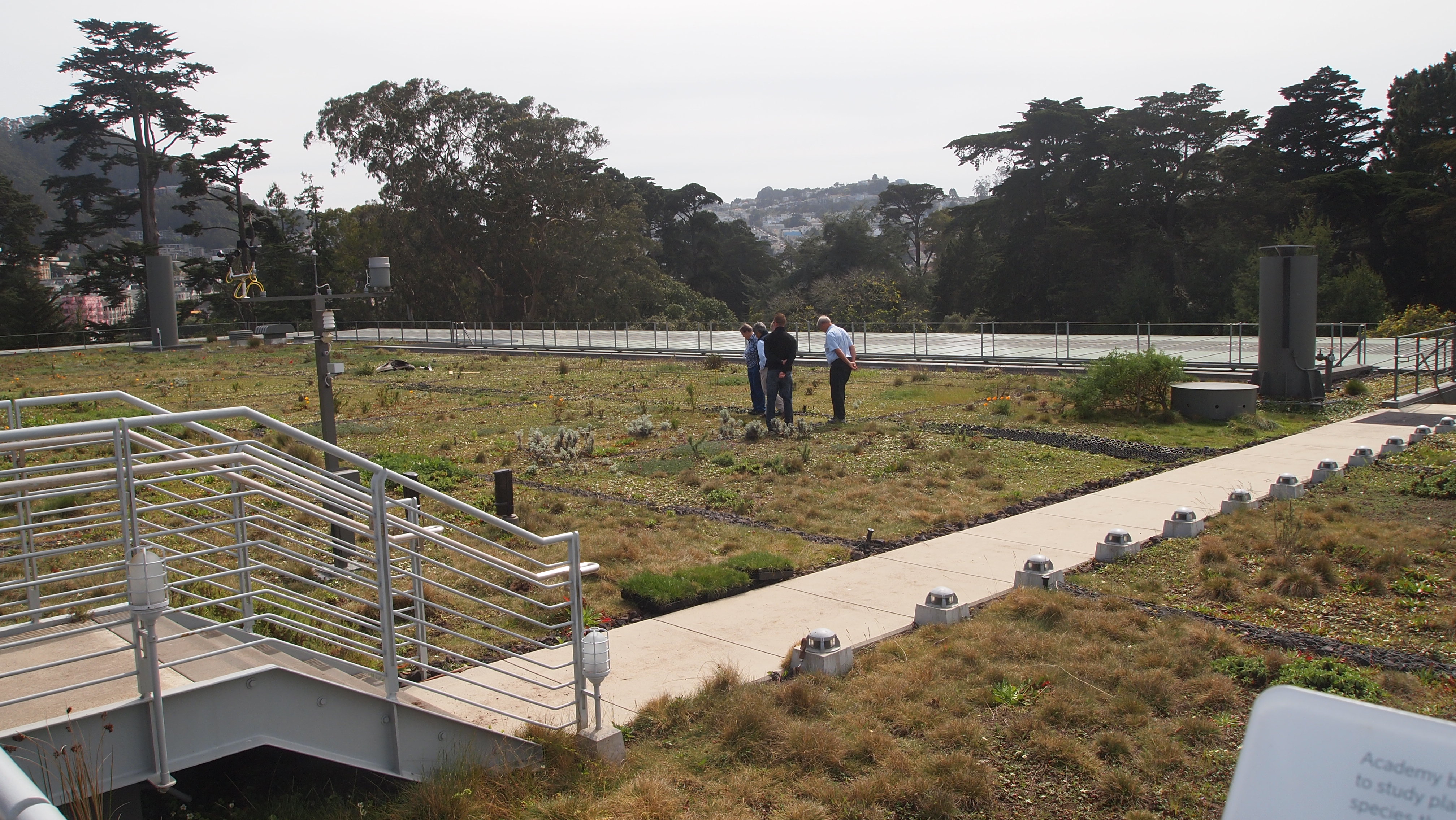
Living Roof at California Academy of Sciences

Living Roof at California Academy of Sciences

At the Academy of Sciences, we visited the Living Roof on top of the building. This roof is covered in grass, plants, rain filtration systems….you name it. According to another placard at the Academy, living roofs absorb most of their rainfall. In fact, the building at the Academy retains 98% of its rainwater, which saves over 13 million liters from flowing into the city’s stormwater/sewer system.  Living roofs also keep buildings cooler, reducing the need for air conditioning, and thus, reducing the release of resulting air pollutants.

Living Roof at California Academy of Sciences

Living Roof at California Academy of Sciences

I also think the incorporation of rooftop gardens or living roofs can provide a little green paradise in the middle of the big city, all without giving up valuable real estate. It’s basically like taking a backyard garden, and simply building it on the roof! Whether a residential or commercial building, a green space on the roof can provide tenants a little oasis, while reducing the building’s energy consumption and resulting pollution, all at the same time.

——————————————————————

The information in this post was gathered through the following sources: U.S. EPA website, www.epa.gov/hiri, and a visit to the California Academy of Sciences rooftop observation terrace. You can learn more about the Academy’s Living Roof at http://www.calacademy.org/academy/building/the_living_roof/.

Graffiti On Broadway

Graffiti can be found throughout Kansas City.  Recently I discovered another treasure trove of graffiti art.  Hope you enjoy it.

IMG_2363

.

IMG_2366

.

IMG_2371Clever, don’t you think?  I wish I knew the artist, but you will see s/he is identified immediately below the shark in the third photograph.

“Great By Choice” Uncertainty, Chaos, And Luck–Why Some Thrive Despite Them All

Unknown

Good luck.  We talk about it. We wish for it.  We blame our failures on lack of it.  Malcolm Gladwell, one of my favorite authors, focuses on it as a significant factor in the success of individuals like Bill Gates in his book Outliers[1].  Gladwell’s insights have been valuable to me in understanding how and why individuals succeed.

Nothing in Great By Choice changes my belief that factors outside our control significantly influence our success.  However, Great By Choice is a reminder that luck alone does not control our destiny.  We are reminded, throughout the book, that we have significant control of our lives, our successes and our failures.

“Are you Amundsen or Scott?” is the question raised in Chapter 2.  In Oct. 1911, Rould Amundsen and Robert Falcon Scott led similar expeditions to the South Pole.  Amundsen reached the Pole and returned safely home.  Scott and his team died in their unsuccessful quest.  What separated the two adventurers?  Both faced the same  1400 mile round trip journey to the South Pole in brutally cold weather, ice, snow and limited supplies.  What made the difference?  According to New York Times bestselling authors Jim Collins[2] and Professor Morten T. Hansen[3], the difference was planning, intensity of preparation, constant vigilance and remaining constantly focused on the goal.

They describe characteristics that enable us to maximize the benefits of our good luck while minimizing the impact of our bad luck.  The authors studied highly successful companies, called “10Xers” ie, companies that beat industry indexes by a minimum of 10 times over a 15 year period, including Microsoft, Progressive Insurance Company. They compare 10Xers to Amundsen, and for good reason.

The book is, fundamentally, about excellence, preparation, and discipline.  The research identifies attributes that 10Xers[4] share with each other (and with Amundsen) that are less likely to exist in less successful companies[5].  A fundamental premise is that luck, good and bad, happens to all of us, and that how we respond, and are impacted by our luck is dependent on preparation, discipline and determination.

By the authors’ definition, luck incorporates chaos and uncertainty, is described as involving events largely outside our control that are unpredictable and have potentially significant consequences.  Factors such as economic downturns, rising interest rates and other economic factors are factors which impact us all.  These are factors the others would incorporate in their definition of luck.  Fanatical discipline, mental independence, empirical creativity, and productive paranoia, are considered by the authors to be essential to success in a world of such economic (and non-economic) chaos and uncertainty.  Specifically, these attributes are considered essential to getting the most from good luck and being harmed the least by bad luck.

Great by Choice identified 3 core 10X behaviors:

1)   Fanatical discipline and mental independence;

2)   Empirical creativity, including reliance on empirical evidence, and direct observation

3)   Productive paranoia, including always planning, and preparing, for the worst case scenario.

1)   Fanatical discipline involves what they label “20 mile marches”.[6]  Differing in every way from frantic forward movement followed by complacency or sliding backward, the focus is on taking measured steps toward success.  It involves the expectation that goals will be clear, that consistent forward movement toward the accomplishment of those goals should be required and that the entity will not indulge in fads or overextend.  Consistent progress, rather than erratic gains and losses, is to be the goal.

2)   Empirical creativity involves individual research and hard date.  Much is made in the book about the importance of “shooting bullets and then cannons”.  The significance of this message is that in taking any risk, it is important to determine, through firing metaphorical bullets, the probability of success.  A bullet is considered low risk, low distraction, low-cost. When such a low risk experiment reaches the target, then it is time to throw significant resources at the target.  The initial example of the concept is based on the idea that if you are on a ship being approached by an enemy ship, you should shoot bullets at the ship until a bullet actually reaches the target ship.  Only then is it prudent to use the resources necessary to shoot a cannon at the ship to destroy it.

3)   Productive paranoia deals with the critical importance of anticipating disaster, i.e. bad luck. Disaster can come in any sources.  It can result from a fluke of nature, a massive recession, a competitor whose product development surpasses the product of another company.  By constant vigilance, preparation, protecting and saving resources an enterprise can maximize the likelihood of working through disaster and moving toward success.

But there is more.  In addition to the uncertainty around us, Great By Choice reminds us that we must always remain above the “death line”.  The death line is identified as an event  under the entity’s control that will destroy the endeavor.  Comparable to corporate death, these are described as risks that can severely injure a company; asymmetric risks (where the potential downside dwarfs the potential upside); and uncontrollable risks, (risks that cannot be controlled or managed.)  Examples of such risk include making financial gambles on products or processes that have not been determined to be likely to be financially successful.  By firing bullets rather than cannons, the authors believe an endeavor can minimize the chances of falling below the “death line” where it cannot survive.

Great By Choice repeatedly conveys to the reader the challenges (“bad luck”) faced by 10Xers and describes how these companies responded to what sometimes seemed to be impossible circumstances.  How they minimized the resulting damage or turned adversity into opportunity.

Whether you are a student, a professional, an entrepreneur or in any other field of endeavor,  spending the time to read books such as Great By Choice can be invaluable in understanding  your “luck” and how to use it (or avoid it!) to be great. 


[1] Among other factors, he argues effectively that the month and year an individual is born, his/her opportunity to have effective mentors, supportive parents, and (often) access to significant financial resources, technology and specialized training, significantly influence an individual’s likelihood of success

[2]  Formerly on the faculty at Stanford Graduate School of Business, author of Good to Great, as well as other notable books focused on business success (and failure), Collins consults with businesses and operates a management laboratory in Boulder, Colorado

[3] Management professor at the University of California, Berkeley, formerly a professor at Harvard Business School and author of Collaboration, Hanson also consults and speaks to and with companies worldwide.

[4] 10Xers studied included such companies as Southwest Airlines, Progressive Insurance and Microsoft

[5] Apple (during the period of time it was not under the leadership of Steve Jobs), Safeco Insurance, and PSA airlines

[6] From childhood I remember the adage “slow and steady wins the race”.

What issues matter to you? Please take our quick survey!

Now that the craziness of election season is over, politicians and constituents alike are getting back into the swing of the “real world.” Of course, that doesn’t mean the politicking comes to an end. With all of the issues facing our nation, I’m curious, what issues are most important to you?

Don’t worry, we’re not trying to conduct an official poll or gain information for any person or organization. We just want to know what our friends and family think and what issues we might explore as possible blog posts in the future.

Soaring

Florida is a place of beauty on the land, the sea and the air.  But I will not forget the beauty of the birds as they soared over the water. Environmentalists in Florida remind us that these birds are vulnerable to the toxins in the environment.

DSC_0115

DSC_0132

xxDSC_0131 2

DSC_0127

The land of egrets and northern shovelers

I went for a walk around the Novato Marsh last week with my good friend David. It was a beautiful day, the sun was shining, and there were birds all around. There were northern shovelers, red tailed hawks in the air, and an egret perched on a slim strip of grass above the water.

With the water reflecting the beautiful clouds above, the northern shoveler swims along with his friends.

With the water reflecting the beautiful clouds above, the northern shoveler navigates his way to his friends.

An egret enjoys a walk in the grass at Novato Marsh.

An egret enjoys a walk in the grass at Novato Marsh.

Inauguration Day/Martin Luther King Holiday

The rock group by the name of the Rascals recorded “People Got To Be Free”, their most enduring hit, in the tumultuous summer of 1968. [1]  Martin Luther King died that spring, at age 39.  Barak Obama was just turning 7.

The words of this song ring true today as they did in the 1960’s.  They were, no doubt, influenced by the life and death of King.  They easily influenced our future President, Barack Obama, as they influenced so many of his generation.  These are the words.

All the world over, so easy to see!
People everywhere, just wanna be free.
Listen, please listen! that’s the way it should be
Peace in the valley, people got to be free.

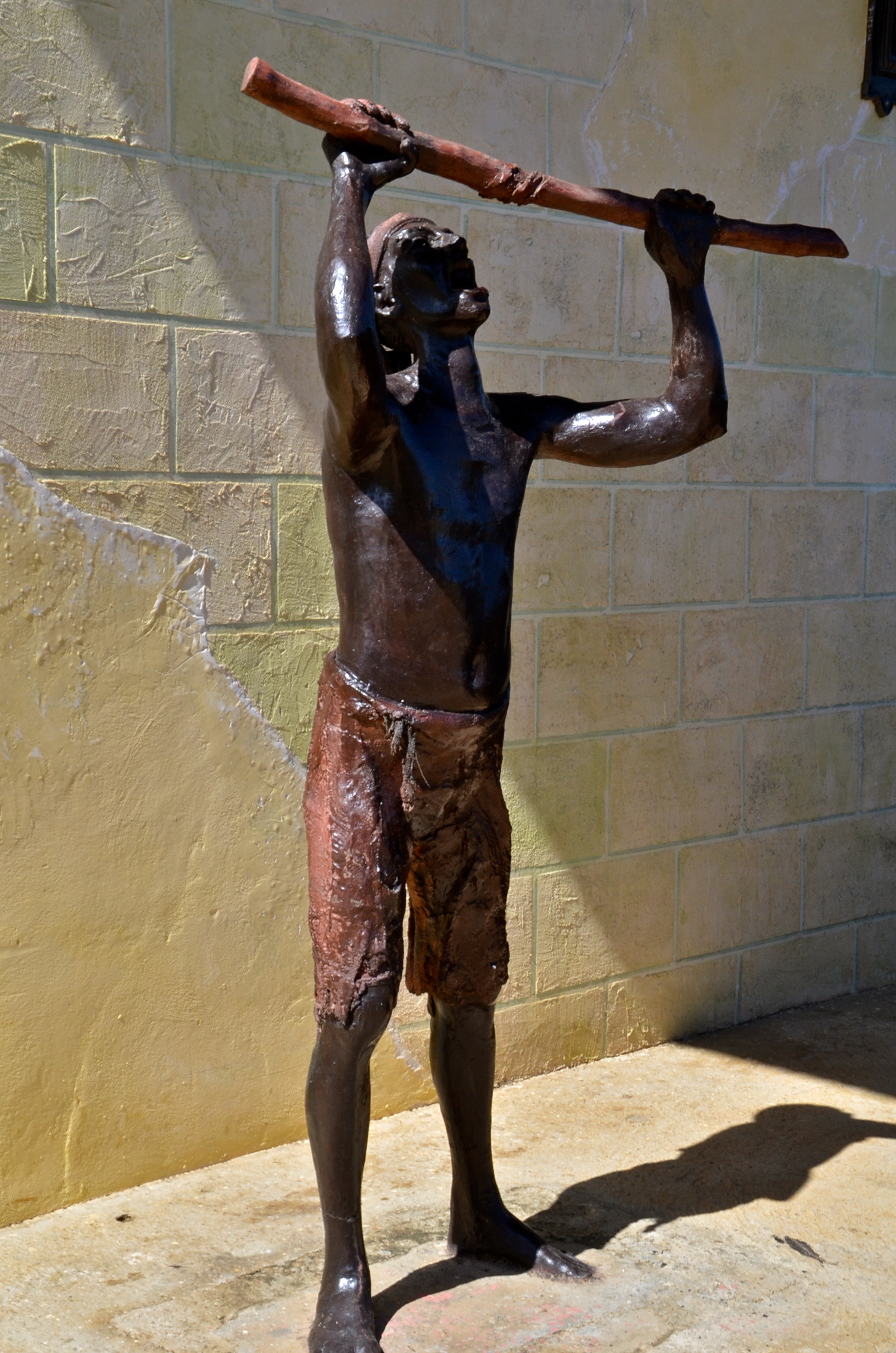
DSC_1059

[2]

As stated so eloquently in the song, “Peace in the valley people got to be free.”  Happy second term, Mr. President.

[1]  Written by Felix Cavaliere and Eddie Brigate, members of the Rascals.

[2]  The statue was inspired by the slave revolts in Cuba in the early 1800s.

________

The opinions in this blog do not represent the opinions of our families, our friends or our employers.

Flora

One of the beautiful things about California is the many varieties of flora you can find throughout the state. My two favorite areas are the wine country and the coast. Both beautiful. Both peaceful. But while the wine country continues to grow in both agricultural and economic development, the coast remains largely untouched. Thanks to the California Coastal Commission, established in 1972, and the Coastal Act of 1976, the use of land and water in the coastal zone is carefully planned and regulated. As a result, the coast north of San Francisco continues to be undeveloped, and flora continues to flourish.

Flora along California Coast at Bodega Headlands

This is a shot from my mini-hike at Bodega Headlands back in November. Since I am usually focused on pictures of the ocean and of sunset, I thought this would be a nice addition to my photographic repertoire. Given, the ocean is still in the background, but these red finger-like plants were simply too interesting to ignore.

Madam Secretary: Hillary Clinton

great_seal_136_1There is a line in the movie The American President, in which Michael Douglas, in his role as President of the United States, explains to his nemesis, that “…being President of this country…is entirely about character.”  As I have studied the three women who have served in the position of Secretary of State, I have come away with the belief that each of these women have proven the quality of their character throughout their careers.  I have written a bit about Madeleine Albright and Condoleezza Rice.  As Hillary Clinton [1] ends her years of service as Secretary of State, I decided to write about her.

A contender for the Presidency in 2012, Secretary Clinton’s years as Secretary of State have only enhanced her credentials.  Will she be a candidate for President in 2016?  Who knows.  Too early to talk about it you say?  Maybe, but in her final days as Secretary, she is providing us the opportunity to understand even more fully her own personal values and priorities without the constraints of  being President Clinton’s “first lady” or President Obama’s ambassador to the world.

As Secretary of State, Hillary Clinton is one of the world’s most influential leaders. [2]  As we consider Secretary Clinton’s character, there is no better vehicle to study her character than in her December 6, 2012, in Dublin Ireland. Want to understand more about the nature of her character?  This speech is a good start.

There are other speeches where she has established her tenacity, her force of will in fighting for peace and in support of U.S. policies throughout the world. But her speech in Ireland [3] focus is less on any single  country or international crisis than on a description of her philosophy of international relations and impediments to healthy governments.

She begins by complimenting her host nation, and describes the important role of Ireland in the creation of the United States.  She continues by describing her belief that human rights is essential to healthy world governments and should be a goal for the 21st century. She describes human rights as “the God-given entitlement of every person”.

Secretary Clinton describes herself as both an idealist and a realist.  She recognizes that in the face of global economic challenges and preventing terrorism concerns about human rights seem to be easily set aside as secondary issues.  Recognizing that temptation, she believes, instead, that respect for human rights is central to building strong relationships and alliances and supporting societies that are stable and economically strong.

At Dublin, Clinton sets forth what she considers to be the most critical human rights issues of the 21st century as follows:

1)  Religious Freedom and the Rights of Religious Minorities–She reminds us that societies are strongest when they deliver justice not just to the powerful, but also the most vulnerable.  She identifies, in particularly the Middle East and North Africa as regions in which governments have been particularly subject to pressure for real democratic change, to a significant extent as a result of their intolerance for the rights and beliefs of religious minorities. [4]

2)  Internet Freedom–Perhaps not surprisingly, she identifies the internet as a major vehicle for criticism and expression that is particularly susceptible to censorship.  She describes her hope that the internet, symbolic of the right to freedom of expression and thought, can become a means of positive communication between leaders and their people rather than a target for a deepening spiral of repression by leaders angry–or feeling vulnerable–as a result of internet protests.  But she also describes ways in which government actions blocking and shutting down communication on the internet–particularly as to tweets, blogs, and even internet underground news sources–have had a brutal impact on dissidents.

3)  The Role of Civil Society–In many ways, her identification of “civil society” actually incorporates each of the three other priorities identified in her speech.  She believes that the United States’ economic and security interest in helping  tilt what she calls “states in the balance” toward accountable institutions with protections for human rights, rule of law, and democratic governance.  She believes that Instead of focusing only on the compassionate aspects of expanding civil society, civil, stable governments offer greater opportunities for new economic markets.  In contrast, she describes why governments  lacking a civil society, are subject to greater risks of instability and increased risk of inflaming global terrorism.

4)  Respect for the Human Rights of Women and Girls–Rather than identifying women’s rights as secondary to the greater issues of human rights, she considers the treatment of females to be “the unfinished business of the 21st century”.  She describes the brutal treatment of women in areas of the world where they are denied health care, an education, and who suffer the violence of female genital mutilation, virtual slavery, victimization through honor crimes.  She grieves over the forced marriages, often at very early ages, of girls who have no protection from the whims of the men around them.  She describes in particular the Pakistani girl, Malala, [4], shot in the head solely because she spoke out for the rights of Pakistani girls to go to school.

Secretary Clinton ends her Dublin speech much as she began it: with a recognition of the very real dangers threatening the United States and the international community.  But she also expresses a belief that working together to secure the pivotal human rights issues described above will help ensure, not only the interests of individuals, but also help ensure peace, aid in supporting economic development and our other most urgent global problems.

While a single speech does not tells us all we need to know about any government figure, it is a starting point.  As she leaves public office, at least for now, it will be interesting to see where her path takes her next.  We will wait to see.

_________________

[1]  Photograph used by Department of State

[2]    Madeleine Albright and Condoleezza Rice preceded her. Each in her own way has created history, each has been described as “a woman of character”.  See post “What do Madeleine Albright and Condoleezza Rice Have In Common” dated April 13, 2012.

[3]  Her speech of December 6, 2012 was presented at the Annual Meeting of the Organization for Security and Cooperation in Europe.

[4]  She also accuses Korea (never described as a religious nation) of running some of the “largest concentration camps in the world.”

[5] See post “I am Malala” dated November 12, 2012.

The opinions expressed in this blog are not the opinions of our families, our friends or our employers.

I Am Malala: Honoring A Young Girl’s Struggle

On October 9, 2012, a Taliban gunman shot Malala Yousafzai [1] as she rode home on a school bus with her friends.  Malala survived.  She was shot in the head.  The bullet lodged in her neck near her spine. Unconscious and near death, with the assistance of the Pakistani military, Pakistani surgeons removed the bullet in Pakistan and, once stabilized, she was flown to England.  She is now recovering in Queen Elizabeth Hospital, Birmingham.  Eventually she hopes to return to Swat to resume her studies.

Malala was born in July 1997.  Named Malala after a poetess and warrior, she was born to lead.  Her Muslim family is from a large Pashtun tribe in Pakistan’s Swat Valley.  As the rest of us bemoaned the treatment of women and girls in Taliban controlled areas of the Muslim world, Malala did something about it. At the tender age of 11, in 2008, with the support of her educator father, she spoke to the press club in Peshawar and asked “How dare the Taliban take away my basic right to education”.  Her advocacy of her right to an education began and has continued throughout the next 4 years.

When the Taliban threatened and burned schools, Malala continued to attend school.  When the Taliban closed schools, she studied until they reopened. While she initially dreamed of becoming a physician, she changed her ambition to a career in government and politics.

By 2009 she was wrote a blog for the BBC, focused on daily life of a girl living under the Taliban.[2]  She continued to write in her blog even as Taliban and the military fought in the streets.  She continued her work even as her father received death threats.  She agreed to interviews within her own country and with the international press.  When her identity became publicly known, she began appearing publicly on television to advocate for female education. She appeared on a UNICEF supported program as chair of the District Child Assembly Swat in support of children’s rights.

In October 2011, Malala was nominated for the International Children’s Peace Prize.  She received Pakistan’s first  National Youth Peace Prize in December of that year.  She was international recognized for her advocacy for education, by the tender age of 15.

A the time Malala was injured, she was fully aware of the risks she was facing.  She may not have known that the Taliban had voted in the summer of 2012 to have her assassinated, but she had received death threats on her FACEBOOK Page and through notes placed under the door of her home.  She went to school anyway.  She spread her message anyway.  She had to know that these threats were not silly acts of bullying by other children.  These threats were real.  But she continued her campaign in favor of her right, and the right of every girl and woman, to obtain an education.

Malala was not a victim of a random bullet.  She was the target of the attack. The Taliban shooters asked for her by name. Undaunted, she continues her recovering, vowing to return to Swat to be educated. Will she return?  I don’t know.  Will she continued her education?  Without a doubt!

As powerful as her early life has been, her attempted assassination has also furthered her cause of universal education.  President Obama, Secretary of State Hillary Clinton, United Nations Secretary General Ban Ki-Moon have all spoken out against the Taliban’s actions, while acknowledging her courage.  Former First Lady Laura Bush described her as “a modern Anne Frank”. Former Prime Minister Gordon Brown, the new U.N. Special Envoy for Global Education, adopting the slogan, “I am Malala”, has initiated a petition drive to demand that no children be denied an education.

As of today, her attackers have not been caught. More than 50 Pakistani Muslim clerics have denounced the shooting. Pakistan has honored her by renamed schools in her name.  Malala’s face and message have spread through tweets, Facebook posts, t-shirts and posters.   The slogan “I am Malala” rings throughout Pakistan and beyond. Her life continues to be a symbol of hope, commitment and courage.

I am Malala.

[1]  Photograph by  “123 people.co.uk”

[2] For her safety her blog was written using a pseudonym.

________________________

The opinions expressed on our blog do not represent the opinions of our families, our friends or our employers.