The Death of Oscar Niemeyer (12-15-1907/12-05-2012)

imagesBrazil has lost a legend:  Oscar Niemeyer died in Rio de Janeiro, Brazil, just 10 days before his 105th birthday.  Any description of his life and work must necessarily include words like: Brilliant, Creative, Celebrated.  These terms barely touch the genius of Oscar Niemeyer. [1]

Though he favored his works throughout Europe, he is probably most widely known for his impact on the design and structure of modern Brasilia, the capital of Brazil.

Niemeyer was educated at the Escola de Belas Artes.  His architectural career began in the early 1930’s. He almost immediately gained recognition for his unique modern style and for a series of early architectural gems.

He designed the Church of St. Francis of Assisi, in Minas Gerais, Brazil.[2]  Unknown-2Completed 70 years ago, in 1943, it was  designed in the “organic modern style”.  The church was not without its critics.  The Archbishop of the region described it as”the devil’s bomb shelter.  [3]

His most recognizable works are incorporated into Brasilia, designed in the late 1950’s and formally recognized as the capital of Brazil in 1960. It was designated as a UNESCO World Heritage Site in 1987.

Brasilia was designed as a planned futuristic city in which the quality of living was enhanced by incorporating forested areas into residential communities, distributing small commercial areas throughout the city, adding cafes, parks and entertainment areas as well as an efficient transit system. These attributes, combined with the gentle rhythm of the architecture are seen, even today, as beautifying and enhancing the life and culture of a community.

The Brasilia Cathedral, officially the Metropolitan Cathedral of Our Lady Aparecida, built in 1958.  It is designed in the form of a crown, with its central glass roof, it is described as being opened to the heavens. [ 4]

images-4

Niemeyer has been widely recognized and has received prestigious awards, including the Pritzker Prize in 1988 and the Royal Gold Medal for Architecture from the Royal Institute of British Architects in 1998.

While it is acknowledged he designed or influenced more than 500 buildings around the world, he is best known for his contribution to Brazilian architecture.  A modernist, he images-1shunned sharp corners and, instead, incorporated sweeping curves in his works.[5]  He described his love of curves:  “The curve I find in the mountains of my country, in the sinuousness of its rivers, in the waves of the ocean and on the body of the beloved woman.”

A true creative genius, his impact on urban design cannot be overstated.  His genius will live on in the buildings he designed, and those that will continue to be built in their image.

[1] Photograph from gpb.org. Taken in 1960.

[2] Photograph from Architizer.com

[3]  Fit for Prayer, Time Magazine, (April 27, 1959)

[4 ]  Photograph from Brazil.Brasilia.  Agencia Brasil

[5]  Photograph from tumblr.com

Watching The Sun Go Down

I have a fascination with sunsets. That much is clear. But finding the perfect sunset? I’ve found a few, and this one comes close. But I’ve never worked as hard to find a gorgeous sunset as I did on Thanksgiving this year. To make room for our big turkey dinner, we hiked up the ridge above Shell Beach. Pismo Beach was to the South and Avila Beach was to the North. It only took 2 miles and about 600 vertical feet, but we finally found the perfect spot. Our reward? A 2010 Roche Syrah, and a beautiful sunset.

Sunset 1

Sunset 2

Sunset 3

Happy sunsetting.

It’s Beginning To Look A Lot Like Christmas

It’s beginning to look a lot like Christmas, here in Kansas City. Hope you have a wonderful holiday season.

DSC_0015

Country Club Plaza

DSC_0007

Ward Parkway

IMG_0373

Crown Center

Italy’s City Of The Dead: Civita di Bagnoregio

Civita di Bagnoregio is a mystical, magical city.  Inhabited by only 14 full time residents, it is located deep in the Umbrian hill country. The city rises from the Canyon below almost totally isolated from the civilization around it.  The last bridge to the city was bombed in World War II.  A single narrow foot path was built after the war to reconnect the town to its neighbor, Bagnoregio.

Civita di Bagnoregio was constructed in the 8th century by Etruscans and was, for a time, part of the Etruscan’s principle route to Rome.  Entry into the town is accomplished by climbing the steep roadway on foot, or relying on a motorcycle or motor scooter.  It is a tourist destination only for the adventurous and the strong.  The trek is almost impossible for the frail or those with small children. For visitors willing and able to climb to Civita, the journey ends by walking through the city gate, carved from the stone over 2500 years ago.SAM_0197

The isolation of Civita results from the ongoing erosion of the rock on which the town was built so many centuries ago.  Because there are so few remaining residents in a town large enough to a far larger population, it is sometimes identified as the “City of the Dead”.  But for those of us who visit, Civita offers a rare opportunity to experience a lifestyle that is, almost literally, from an ancient time.  Only the few tourists, and the occasional motorcycle, give us any clue that we are living in the 21st century instead of the middle ages.

The inaccessibility of this destination is a testament to the tenacity of its residents.  There are more restaurants than residents. Visitors are few, but those who enter Civita are fortunate to visit a town almost totally untouched by the outside world.  Restaurants serve food that is hearty and filling.  It is cooked from simple ingredients over the heat of small, open fires.  Cold drinks are in short supply. The architecture of the town is truly unique, even in a country of ancient buildings.

If you want an experience of a lifetime, visit Civita di Bagnoregio.  You won’t be sorry.

“Equal: Women Reshape American Law”

IMG_0287Until the late 1960’s law schools were almost exclusively a bastion of white, male students.  By the late 1960’s, law schools saw themselves with empty seats when, during the Vietnam War, male students lost their selective service deferments, were drafted, and unable to enroll in or finish their legal studies. Unwilling to accept the lost enrollment dollars, In Equal: Women Reshape American Law, Fred Strebeigh opines that the very schools that had rigidly limited enrollment to white males in the past, began to enroll women and people of color to fill those empty seats.[1]

Strebeigh tells the story of how a rapidly increasing cadre of women, on completing their legal educations, found that they were not welcome  in the profession for which they had prepared.  Law firms, law schools and the courts did not want to hire them, regardless of the strength of their academic credentials.  He describes the willingness of these talented women to challenge the institutions and laws that perpetuated discrimination against them.  But the strength of Equal is based, primarily, on the story of the dedication of women, and often their male allies, to search out cases to litigate that would, systematically, rely on the language of the U.S. Constitutional to break down the barriers to full equality between the sexes.

By the beginning of the twenty-first century, women made up 47% of law students, 35 % of the law faculty, 30 % membership in the American Bar Association, 23 % of federal judgeships. But it is not just the number of students, it is also the impact of the litigation by this new generation of lawyers that is the core of this book.  Strebeigh tells story after story of the people behind the most significant cases of the 1970’s and 1980’s.  He describes the impact of sex discrimination on individual men and women. He explores the inability of women to obtain scholarships to pursue their legal studies, the inability of an Army nurse to continue her military career after becoming pregnant, giving birth and giving her child up for adoption.  He describes discrimination against males in the receipt-or inability to receive–government benefits available to women.  He describes violence perpetrated against women, including rape and other sexual harassment, in circumstances in which employers, universities or the courts refused to hold their male abusers accountable.

Last month I wrote about the struggles endured by women leaders who led the fight for the Nineteenth Amendment, ie. the right to vote.  Their struggle made possible the successes of the more recent past.  Strebeigh repeatedly returns to the stories of the 19th century to explain the history that had to be overcome for the equality of the sexes to come to fruition.

A special hero in Strebeigh’s book is U.S. Supreme Court Justice Ruth Bader Ginsberg.  After graduating from Columbia Law School [2] she served on the faculty of Rutgers Law School from 1972 until 1980 and the faculty of Columbia Law School.  During her academic career she became deeply involved in researching and litigating on behalf of victim’s of sex discrimination, both male and female.  Highlights of her career as an advocate are Supreme Court cases that extended the protections available to women, and eliminating barriers to equal treatment on the basis of sex.  She researched and argued before the Supreme Court: Reed v. Reed, [3] Frontiero v. Richardson, [4] Weiberger v. Wiesenfeld [5] and Duren v. Missouri. [6]  

Equal begins in 1967-68, and continues into the beginning of the 21st century.   Strebeigh tells is the story of the impact of women at a national level.  He describes successes as well as failures in the period of his studies.  It is, in some fundamental ways, the story of my generation of women attorneys.  The story of Meg’s generation, what I call the Title IX generation, remains to unfold.
__________

[1] Enrollment by African-Americans and other people of color also slowly began to increase.  However the opportunities and challenges of these groups are covered in other books and only briefly mentioned in Equal. 

[2]  Justice Ginsberg began her legal education at Harvard Law School.  In 1960 she graduated from Columbia Law School where she tied for first place in her class. She served on the law reviews of both schools.  Despite being denied a position as Law Clerk to Supreme Court Justice Felix Frankfurter due to her sex, she excelled in every future aspect of her career.  While at Rutgers she became deeply involved in the women’s rights movement.  She co-founded ACLU’s Women’s Rights Project, and served as ACLU’s General Counsel before being first appointed to the U.S. Court of Appeals for the District of Columbia Circuit in 1980 and thereafter moving to the Supreme Court in 1993.

[3]  In 1971 the Supreme Court held in Reed v. Reed that Idaho’s law that case mandatory preference to males in selecting administrators for probate estates was in violation of the Equal Protection Clause of the Fourth Amendment. 

[4]  In 1973  the Supreme Court held in Frontiero v. Richardson that  the Fifth Amendment’s Due Process Clause prohibited discrimination between men and women in distributing military benefits to dependent family members.

[5]  In 1975 the Supreme Court held in Weinberger v. Wiesenfeld that gender based distinctions under 42 U.S.C. 402(g) gender-based distinction in the distribution of special child care benefits violated the right to equal protection under the Due Process Clause of the Fifth Amendment.

[6]  In 1979 the Supreme Court held in Duren v. Missouri that Missouri’s statute making jury service optional for women violated a criminal defendant’s right to a fair cross-section requirement of the Sixth Amendment.

___________

The opinions on this blog do not represent the opinions of our family, our friends or our employers.

Sheila’s Passion For Health

Last Christmas after Meg and I told friends about our new blog at a holiday party, Sheila promised to become our first “follower”.  We didn’t know anything about followers, but we figured it out, her blog on healthy living became the first blog I followed.  I have read her blog faithfully ever since.

Sheila is truly passionate about healthy living, not just for herself, but for those around her.  She talks about obesity as an epidemic and wants to help others live healthier lives as she documents “my journey to better health”.  Her blog describes her commitment exercise, eat well, savor life.  Consistent with her theme, she recently changed the name of her blog to “Livliga Live Vibrant Blog”.  Livliga, translated from Swedish, means to live vibrantly, in an energetic, dynamic or lively fashion.

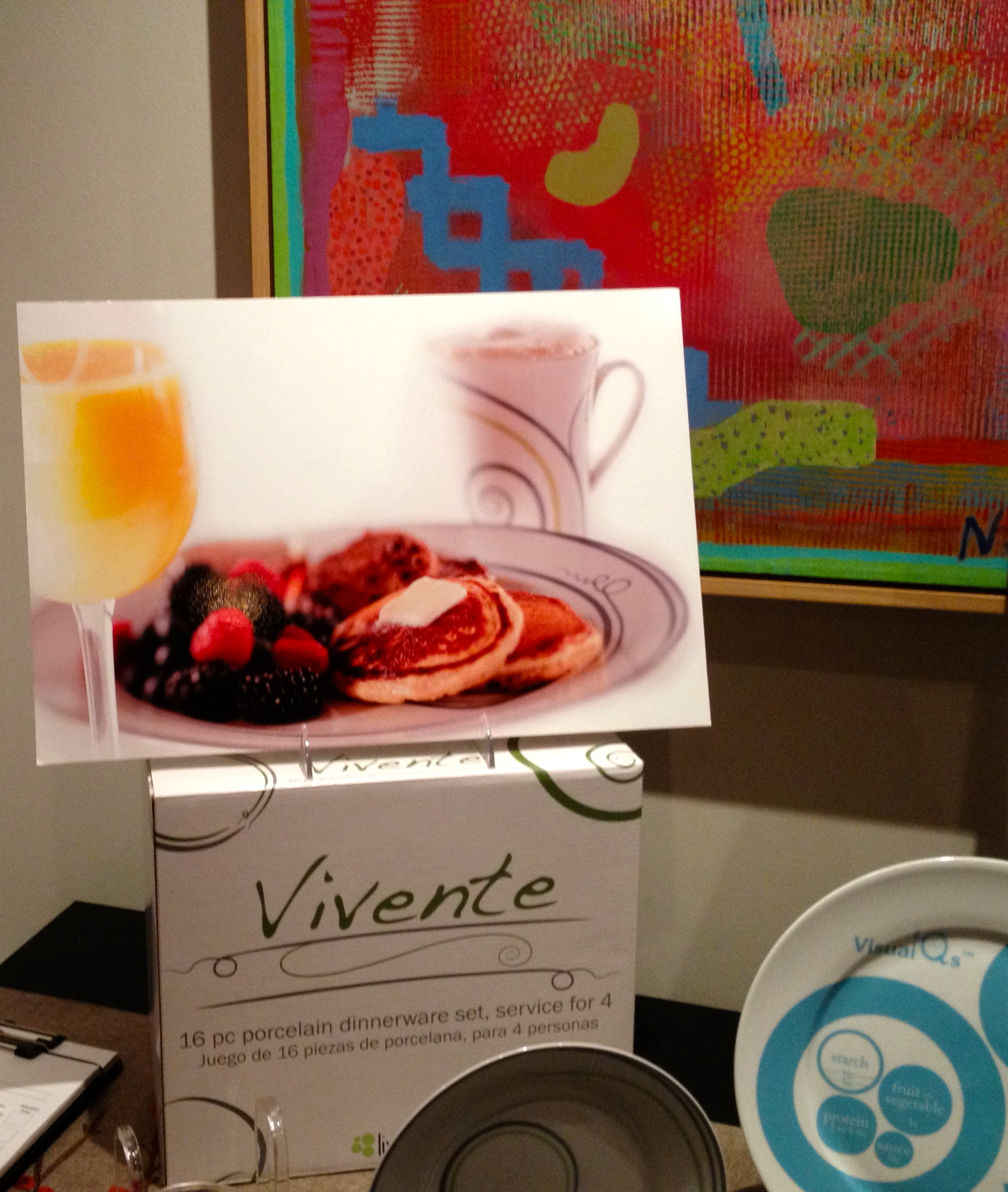
Sheila has now created a line of Livliga dinnerware products designed to help us “right size” our food portions.  Believe me that when she talks about her commitment to healthy living, portion control, and her dinnerware, her enthusiasm fills the room.  She describes her dinnerware as providing “a great reminder of what the right amount of food really looks like”.
Until recently the Executive Director of the Denver Affiliate of the American Heart Association, she takes health seriously.  She is an evangelist, of sorts, in her advocacy for eating healthy foods with appropriate portions for weight control. In addition, and this is where her passion for health has taken an unusual twist, she believes, and causes us to believe, that how food looks on a dinner plate is critical to our sense of satisfaction.  Food that is appealing and visually “fills a plate” gives us the ability to decrease the amount of food we need to feel full.

Important as her message is about portion control, Sheila wants us to be happy as we diet.  Her blog regularly features great recipes for foods that are appealing to our senses of taste, smell and sight. If we are eating less, she wants to be sure we are eating well.
Trust me when I tell you that after reading Sheila’s recipes for mustard sage grilled chicken, grilled salmon and flank steak, I really wanted to try them.  Her photos of prepared from her recipes look wonderful.  A right sized portion of her chicken, according to her post, is only 286 calories.  With a tasty Mediterranean lentil salad, the dinner counts is still only 492 calories.  Healthy, tasty and diet friendly, what more can we ask.
If  Sheila has anything to say about it, we will live healthier, feel better and enhance the overall quality of our lives.  Her mantra may well be described as “Eat thin, live vibrantly, Livliga!

Sailboats in Morro Bay

Continuing our journey south along Hwy 1, we stopped in Morro Bay for a wine tasting overlooking the water. We were so excited when we discovered the magnificent formations between Morro Bay and San Luis Obispo called the “Nine Sisters.” This chain of volcanic peaks/hills ranges from 576 ft. (Morro Rock) to 1,559 ft. (Bishop Peak) in height. Morro Rock, the smallest of the nine, is the rock you see in the picture below. It sits out in the bay, overlooking the ocean, and is a beautiful place to sit and watch the sunset. Since you all know I love a good sunset, I thought I would share this beautiful scene with you. The sailboats are for Pud:)

Happy sunsetting.

The snowy side of California

Most people think of sunshine and warm weather when they think of California. There are many different faces to the weather here, and though sunshine and warmth comprise one of those faces, there are others. We have rain in the winter, fog just about all year round, heat, cold, and if you’re in the right place, snow.

Earlier this month I traveled through Donner Pass on my way to Nevada. You go through the pass while driving along I-80, on the east side of California, before you cross into Nevada and then get to Reno. It’s a beautiful area, with amazing views of the Sierras and surrounding lakes. The pass got its name from a tragic event in the winter of 1846, when the Donner Party traveled through the lowest notch they could find to cross the Sierras and make their way to California. The pass was the “lucky” traveling point, however, it was blocked by snow at the top, and the group had to spend the winter on the east side of the pass. Only half of the travelers survived the winter. Some resorted to cannibalism to survive.

A tragic story indeed, but Donner Pass is a beautiful part of the country nonetheless. I have yet to see any snow here in Sonoma County, so spending part of my day driving through a snowy pass was actually quite exciting. Who knows, a ski trip or two may be in my future.

Tapestry Or Sculpture: It is Clearly Fine Art

If I thought I had any understanding of African art, this sculpture by Ghanian artist, El Anatsui, caused me to reexamine by perceptions.  Shimmering like silk, the 350 pound work of art is currently being installed on a wall in the Bloch Lobby at the Nelson-Atkins. It is entitled Dusasa I.

Described by the museum as a tapestry-like sculpture, it is 39 ft by 26 ft and weighs 350 pounds.  Constructed from recycled aluminum bottle tops and the strips that encircle the bottle necks, the artist and his assistants flattened the thin metal before beginning their artistic work, fastening the metal strips to create this complex quilt-like pattern.

The Dusasa I donated to the Nelson by the William T. Kemper Foundation.  It is one of many works the Foundation has donated to the museum.  The donation reflects the impeccable standards of both the William T. Kemper Foundation and the Nelson.

For Kansas City residents it is another reason to visit a home-town treasure.  For anyone living outside the Mid-West, it is one more reason to visit the heartland.


Paper As Art

On a recent visit to the Nelson-Atkins Museum of Art, I saw these creative paper ornaments in the Museum Store. Reminiscent of the crafts we learned in second grade (or third, or fourth, I don’t really remember) these cutouts bring cut paper to a whole new level of artistry.

With light shining through them they also appear to be distant relatives of the luminaries we passed as we drove up to the gallery.

You can try to make these with your little ones or, perhaps, you can visit the museum and bring them home to display in your windows through the holiday season.