In Search of Dvarapala

Mysteries are just facts waiting to be discovered.  Since research is as exciting to me as sports are to some of my friends, I love a mystery.  Taking a hiatus from family research, I was trying to come up with a project.  The one that came to mind was  staring me in the face, literally.  It combined Indian history, religion and art.  Perfect, I said to myself.

Over 30 years ago I stumbled on two wonderful little statues in a small antique store.  They were a bit pricey for my recently out of law school budget.  Fortune smiled on me.   I was the only customer who fell for these unusual pieces.  Months later, I returned to the shop. Both statues were still there.  They were discounted and I took the plunge.

I was told the statues had been salvaged when a Hindu temple was destroyed.  They were supposedly purchased by an interior decorator who traded them to the antique dealer as partial repayment on a loan.  I took them home, tried to research them, gave up and put them where I can enjoy them!

The most interesting of these statues (don’t tell the other one) is pictured below:

It is a wonderful carving but other than the dealer’s story, I had no real understanding of his significance.  Technically, he is a “wood & polychrome” statue, meaning only that he is painted in a variety of colors.  It is obvious he has been repeatedly repainted, suggesting only that he is not new and, perhaps, that he was designed more for utilitarian, than artistic, purposes.

A lot has changed in 30 years.  I realized with the internet I should renew my search.  I began by searching terms including Hindu statue, guardian, Hindu art and Indian art.  Eventually I came across the term “Dvarapala” [1] meaning guardian deity, door guardian or wrathful deity. Dvarapala is associated with the temples, shrines  and monasteries of Buddhism, Taoism and Hindu religions.  They are found in such countries as India, Burma, Tibet, Malaysia, Japan, Sri Lanka, Cambodia and China.  These guardians have played a significant religious role throughout much of the world for over a thousand years.

Initially the images of Dvarapala I found on the internet were massive stone or bronze sculptures of ferocious warriors.  Ultimately I came upon a reference to more benign sculptures and continued my quest. Finally, I googled “Dvarapala, 1800s” and discovered this wonderful late 1800s statue, also identified as “wood polychrome”.  The Jaipaul family donated it, with other Indian and Tibetan sculptures, to the Allentown Art Museum, [2] in 2000:

While certainly of finer quality than my own statue, the similarities satisfy me that my home and family are well protected by a Dvarapala.  I promise to treat it with the respect it deserves as a representative of a deity not my own.

__________________________

[1]  In Buddhism “Dharmapala” identifies a wrathful  protector who, similar to the Dvarapala, often guards a monastery or other religious building.

[2]  Allentown, Pennsylvania
Back In Time–The Dillingham-Lewis Museum

Morgan Vachel Dillingham was born in 1843 to Joshua Robert Dillingham and Susan Jane Walker.  He fought, and was wounded, in the Civil War.  He served with confederate forces.  On his return from the war, he found his family home had been inhabited by the Mock family.  He married Melvina Mock.  The log cabin in which they lived is now located at Missouri Town.

Morgan and Melvina ultimately built the Dillingham home at 15th and Main, in Blue Springs, Missouri.  They owned a general “mercantile” store. He was a bank vice president/president. [1]  His family had a large farm in Eastern Jackson County, Mo. This photograph of the Dillingham family in 1914 identifies a couple, “Ma D and Pa D” presumably Morgan and Melvina.

Morgan and Melvina’s son, David Morgan Dillingham, was born 1873.  He married Mary Estella Spicer in 1898.  Morgan and Melvina built them a home on property adjacent to the Dillingham home.

Known as the Brownfield House, it is where David and Estella raised their family.

David owned a gas station and a store. In January, 1955, David was shot and killed in a botched robbery at his store.

David’s daughter, Margaret, was raised in the Brownfield House. She married Wade Brownfield. They also raised their family in the Brownfield House.

The Brownfield House was sold privately and has been beautifully restored.  The Dillingham House was eventually sold to Narra Lewis who, in 1977, sold the home to the Blue Springs Historical Society. It is now a museum, and also houses the historical society.

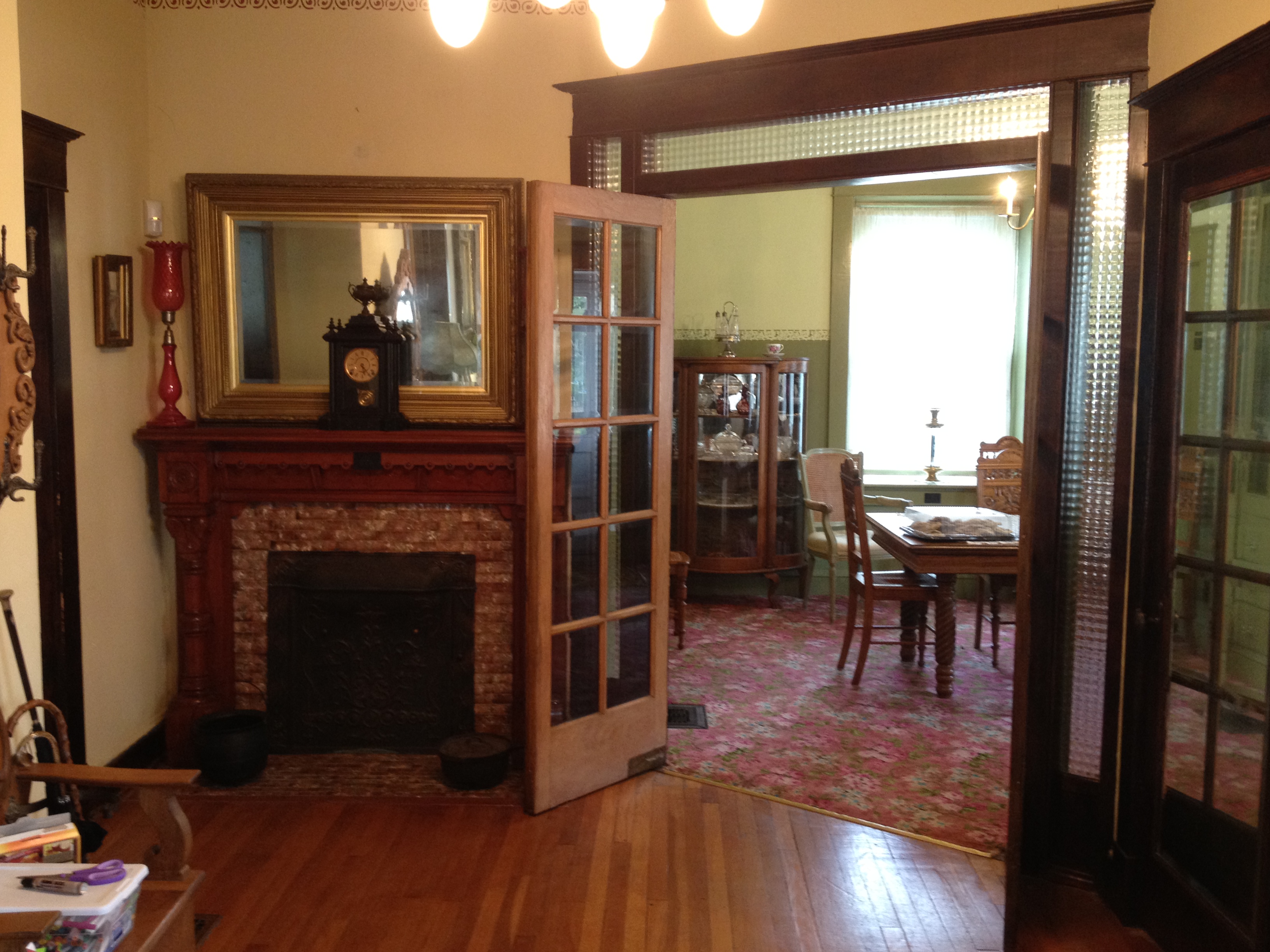
The museum has been decorated in period pieces consistent with the styles of the early 1900’s, approximately 100 years ago.

While the furnishings are not original to the home, the interior of the house nonetheless reflects the style of the early 1900’s.  It is lovely, reflecting the graciousness of that time.

The museum is open to the public for only a few hours a week.  It is worth a call to arrange a tour and to glimpse a slice of life in the earliest years of the 20th century.

[1]  Sources are inconsistent as to his role at the bank

Ancient Deities, Familiar Truths

As the world shrinks, we benefit by our willingness to gain an appreciation and respect for the diversity surrounding us.  There is much to be gained by finding common ground with those whose cultures we have never experienced.  I have so much to learn.

Buddhism and Hinduism are both ancient religions with their origins in India. the roots of Hinduism easily extend more than a thousand years before the birth of Christ.  They are cultures both rich and full of meaning.  To my Western understanding, there are similarities between the two religions that might reasonably be compared to the similarities between Jewish and Christian origins, beliefs and traditions.

While Buddhism and Hinduism both recognize many deities, they do not represent separate gods, but rather different manifestations of one God.  Some of these manifestations are quite strange to us; and each of these deities may have multiple roles.  Additionally, some Buddhist deities originate in Hindu traditions:

[1] Ganapati/Ganesha

[2] Vidyaraja

These symbols of their God, however foreign to us, should not deter us from understanding the universal truths which are part of these faiths.  Many of the beliefs of Buddhist and Hindu teachers could come from the mouths of our own spiritual leaders, still others, are worthy of our respect.

Buddhist Quotes:

Three things can not be hidden; the sun, the moon and the truth.  Buddha

Health is the greatest gift, contentment the greatest wealth, faithfulness the best relationship.  Buddha

In this way, all here are the same, whether rich or poor, educated or uneducated, Easterner or Westerner, believer or non-believer, and within believers whether Buddhist, Christian, Jewish, Muslim, and so on.  Basically, from the viewpoint of real human value we are all the same.”    The Dalai Lama [3]        

If there is love, there is hope to have real families, real brotherhood, real equanimity, real peace.  If the love within your mind is lost, if you continue to see other beings as enemies, then no matter how much knowledge or education you have, no matter how much material progress is made, only suffering and confusion will ensue.  The Dalai Lama [4]

The greatest quality is seeking to serve others.  Atisha [5]          

Hindu Quotes:

I came to the conclusion long ago…that all religions were true and also that all had some error in them, and whilst I hold to my own, I should hold others as dear as Hinduism.  So we can only pray, if we are Hindus, not that a Christian should become a Hindu…But our innermost prayer should be a Hindu should be a better Hindu, a Muslim a better Muslim, a Christian a better Christian.  Mohandas Gandhi [6]

A coward is incapable of exhibiting love; it is the prerogative of the brave. Mohandas Gandhi


___________________________________
[1] Ganapati/Ganesha–Ganapati is the Buddhist wealth deity.   Ganesha is the Hindu god of wealth and success
[2] Vidyaraja was apparently a Hindu deity incorporated into Buddhism.  He has many images representing  such attributes as purification of the mind, wrath, protection of believers, eliminating evil.
[3]From Kindness, Clarity and Insight
[4] From the Path to Tranquility
[5] 11th century Tiebetan Buddhist master
[6] Quote similar to quote by Sri Sathya Sai Baba, born 1926 “I have come not to disturb or destroy any faith, but to confirm each in his own faith-so that the Christian becomes a better Christian…”
The opinions in our blog do not represent the opinions of our families, our employers or our friends.  They do from time to time represent our attempts to understand the world around us.  If we are in error in our understandings, we are happy for caring corrections.

Continuing My Search For Ancestors

Hearing from a possible relative is thrilling.  This is how the message begins:

“Hi Ann, Hearing from a newfound family member is always exciting! . . . You and I would be 2nd cousins by marriage.”

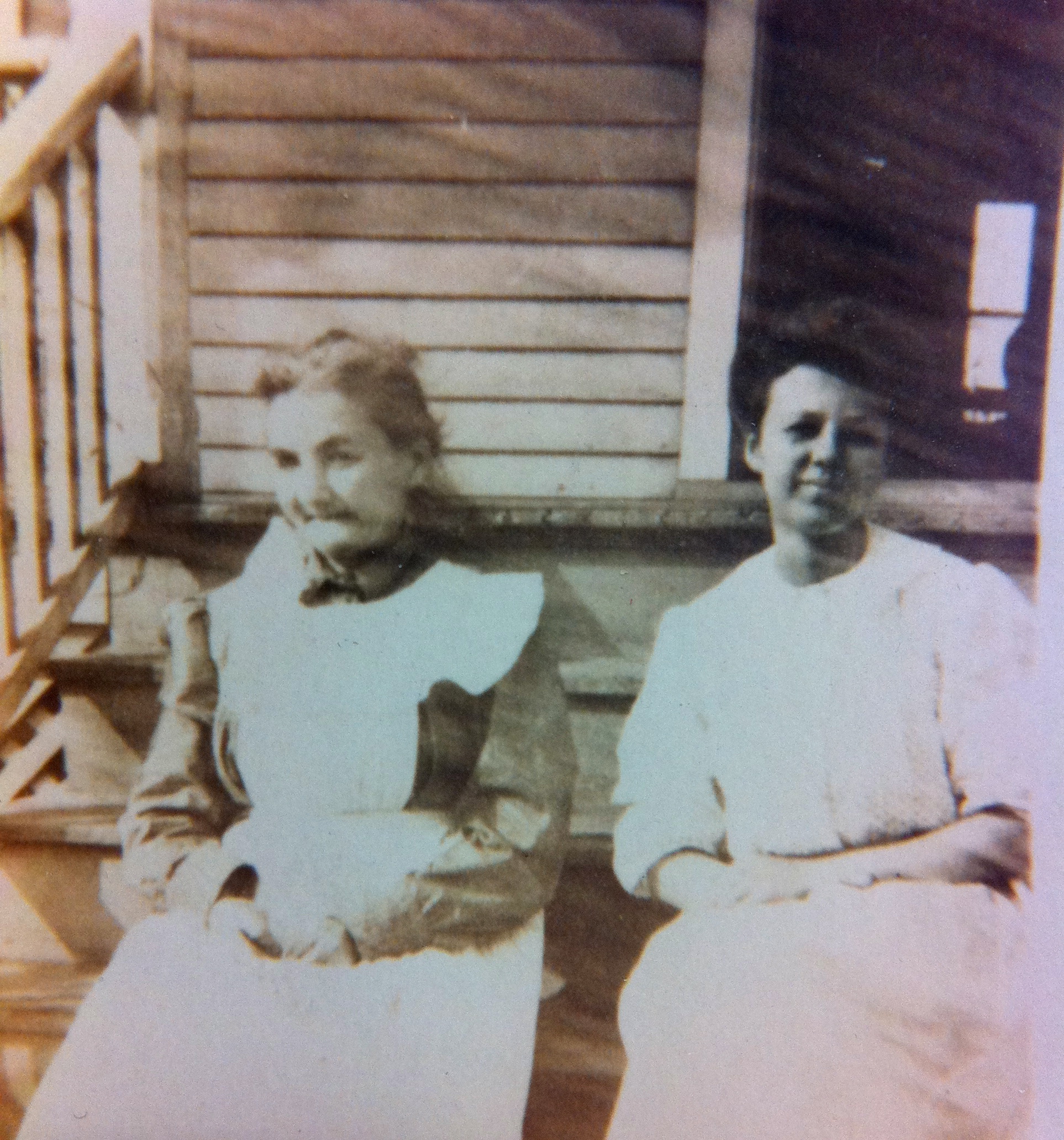
Our possible common ancestor was Conrad/us Kirs/ner, father of my great-grandmother, Catherine Barbara Kischner.  Catherine’s children knew her as “Kate”.  This photograph of Kate was taken shortly before her death, on Dec. 28, 1910.  She was living with her daughter, Anna Landes, in Niagara Falls, NY.  My granddad, Frank C. Mesle, Sr., owned the house next door.Kate may have been born June 16, 1850/7.

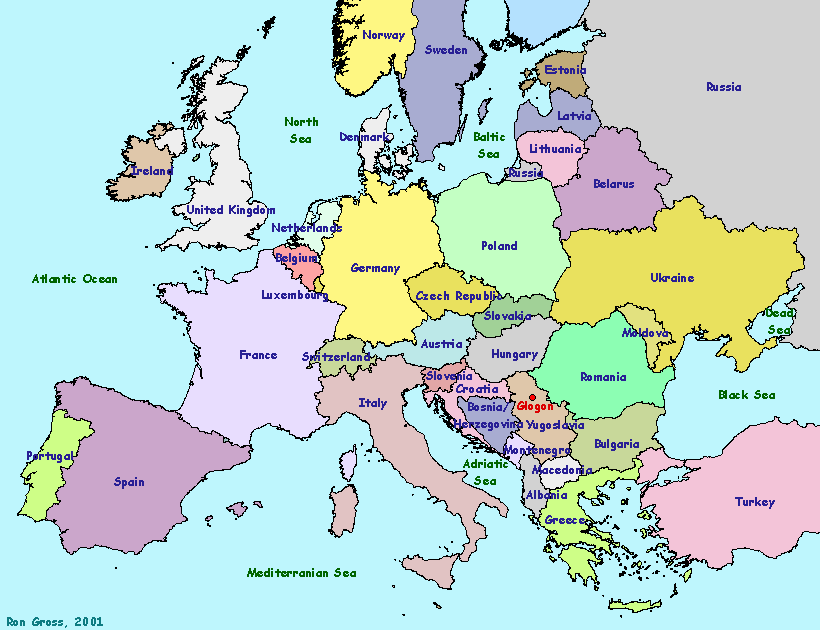
Our family history, and the 1910 U.S. Census, are consistent that she was born in Germany.  Sources at Ancestry.com, including my newly connected second cousin, disagree, and believe she was born in Glogon, Austria-Hungary.

Glogon (now Glogonj) is currently part of Serbia. Between the mid-1800’s and the present, Glogon has been part of Austria-Hungary, Hungary, Yugoslavia and, now, Serbia.  It is strategically located between what was, in the 1700 and 1800’s, a buffer area between Christian Austria-Hungary and the Moslem world.  Apparently settlers were given free land to entice them to move there to provide a buffer between the two cultures.  It was certainly a bad bargain. They lived a difficult life at best. Apparently death rarely resulted from old age, but instead from disease, starvation or warfare.  By the late 1800’s there was a massive exodus from Glogon to other areas of Europe and to the U.S.

Selfishly, for me, my probable link to Glogon helps explain my DNA test results, that indicates I have DNA markers for Southern Europe and, perhaps, the Caucasus, near the Black Sea.  Obviously Glogon is located far closer to Italy than to the country I had believed to be her home, Germany.

Kate received a series of letters from her family between 1896 and 1911. All were addressed from Germany.  Each includes some tidbit of news pertinent to the family history.  They are as follows:

Letter from C. Kirsch (probably her brother) dated Jan. 22, 1897 from Ludwigshafen (at the Rhein), to the Kaisers German Consulate in Toronto, Canada: He identifies Barbara Kirsch as his sister, states his father’s third wife “died last year” and that his father, who is very weak, will be 76 in March.  He states that of the “brothers and sisters there are , besides myself: a sister, Elise Fromhold, a widow, who lives in Neckargemund.  Elise was Conrad’s daughter by his first wife, as was Kate. A brother Frederick[1] Kirsch, was a teacher in Sonborn, Elberfeld, of the second wife.

Letter from C. Kirsch dated July 16, 1901, from Ludwigshafen to Barbara Mesle, born Kirsch, in Niagara Falls, NY:  He explained he was sending Barbara her 1/4 share of her father’s estate, 2000 marks, ($478.16).  He identified his eldest daughter as Lenchen, and his son as Fredrick.

Letter from Elisa Fromhold dated July 29, 1907, from Neckargemund: It is addressed to “Dear Sister” and  identified her daughter, Marin, as nurse in Mannheim, another child as Jungfer, who lived in  Durtheim (Durbheim?).

Letter from Elise Fromhold dated August 1, 1911, from Neckargemund: It is addressed “Dear Aunt”(?) and was received by the family several months after Barbara’s death. It identified the author’s children, Dina, Karl, Uncle Konrad and Uncle Friedrich.  I assume, but do not know, that this is from a daughter of Catherine’s sister, also Elisa/e.

The correspondence from a possible cousin, who I have never met, is exciting.  She identified another brother of Kate’s, Josephus Kirschner, born September 8, 1855, in Glogon.  He has long been identified on the margins of my notes as a possible relative. Her ability to give me what may well be another piece of my great-grandmother’s history assists me, piece by piece, to trace the history of my family.

Have a great week.

__________________

Frederick is also the name of one of Kate’s sons

In Honor of our Readers in India and Tibet

Eastern cultures are so rich with history, religious belief, the arts and education.  As a result of Meg’s posts on Natasha’s wedding ceremonies, we have a fair number of readers from India, the Philippines, Pakistan, Singapore, Bangladesh, Indonesia–the list goes on.  We are grateful for your interest in our  blog.

From time to time we would like to share some of the wealth of art and wisdom that originates from cultures other than ours.

A good friend, born Catholic, has spent a lifetime studying Eastern religions and acquiring art, primarily from India and Tibet.  His collection, primarily of Buddhist sacred and less sacred, carvings, fabrics, and decorative objects, surround you throughout his home.  Because he has attempted to capture the environment of a shrine, he uses dim lights and wraps his statues in beads, strings of light, fabric and other symbols of respect.  I will include posts on our blog that include photographs of his collection.

He is not a wealthy man so he is not competing with museums in his acquisitions. That in no way diminishes the beauty of the art.   The cultures reflected in these works are truly to be treasured:

Buddhist (and Hindu) female deities are generally crowned, serene in demeanor and adorned with beads.

Tibet’s fabrics are often ornate and generally rich with color and design.  Tibet clothing can be quite lovely, with ceremonial clothing full of color, intricate design and elaborate headgear. In the West we are fortunate to see examples as banners, wall hangings and prayer flags. Even such examples give us a sense of the beauty of their design.

While I love the beauty displayed from various works of art.  I am grateful for corrections as I stumble with identifying various deities and ornamental items.  Please feel free to correct me or to provide us with additional information.

We wish you well.

The Little Free Library–Blue Springs Style

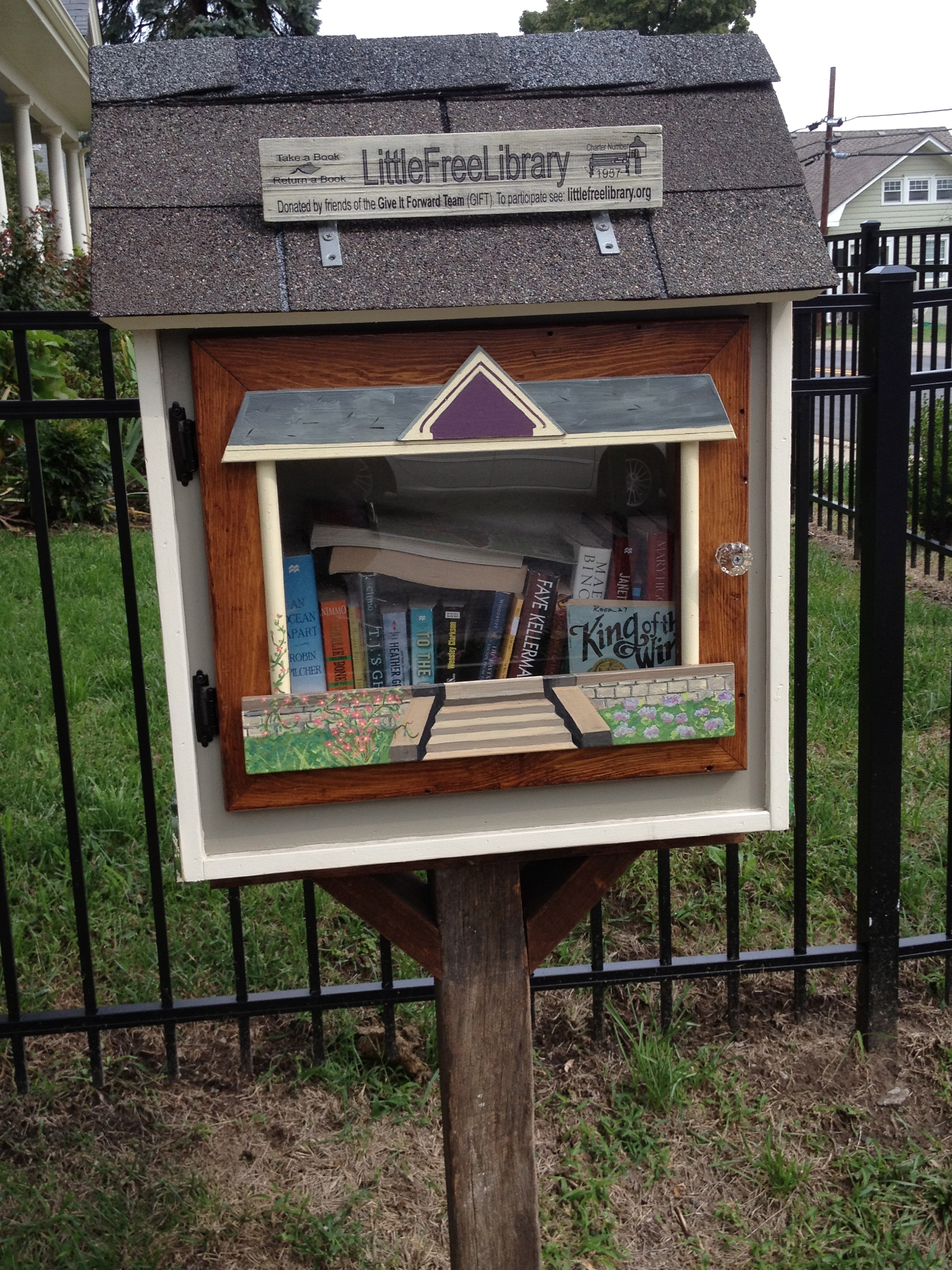
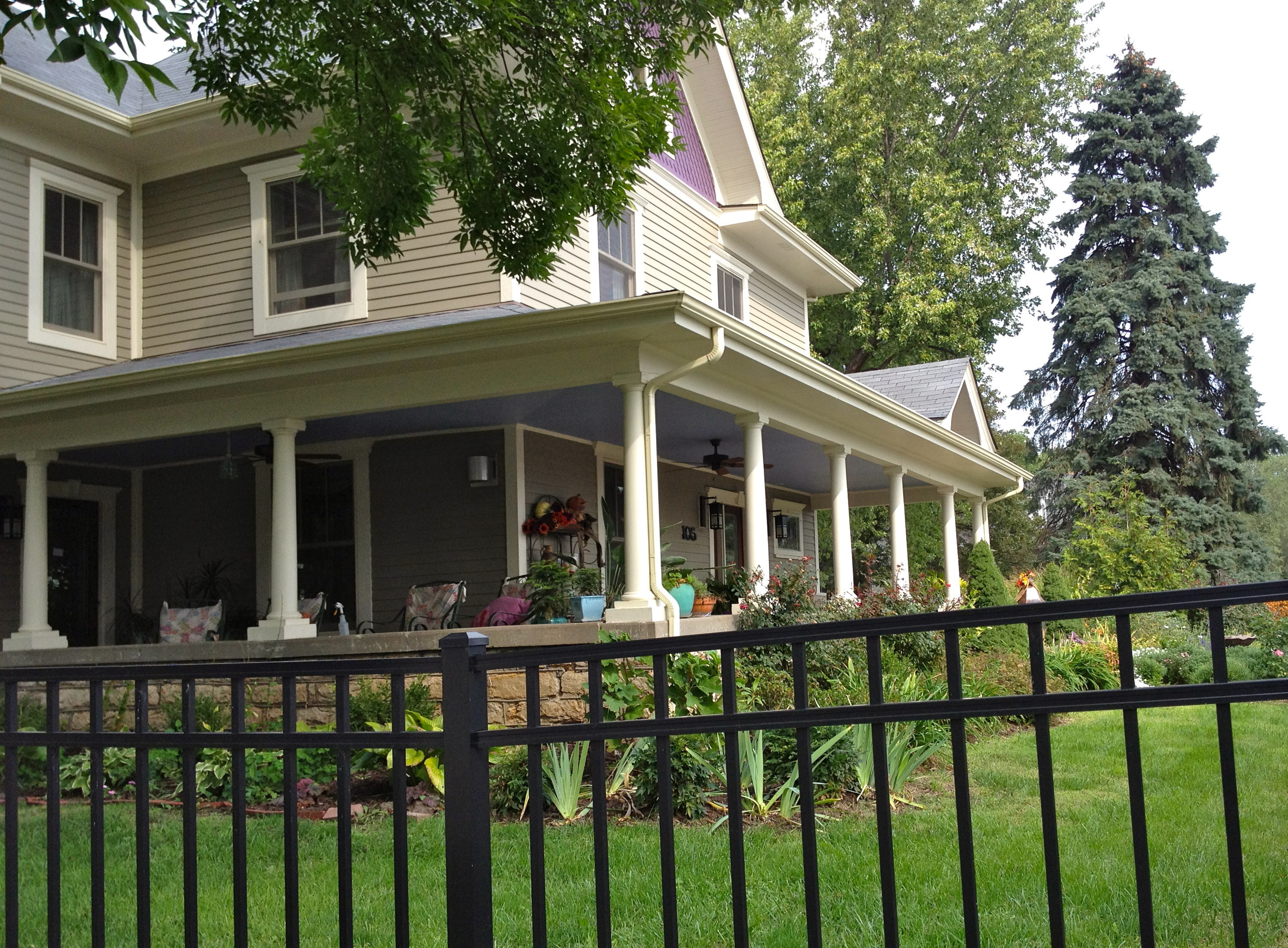
As I was photographing the Brownfield House for yesterday’s post, I saw what appeared to be a slightly oversized bird house.  Fascinated, I aimed my camera for a shot only to see through the viewfinder the words “Little Free Library”.

Last week I first heard about “The Little Free Library”.  It is such an exciting concept.  Begun in Madison, Wisconsin, it has already spread to California and has recently begun making its way into the heartland.

The goal of The Little Free Library project is to encourage businesses and individuals to establish their own tiny libraries to make books easily available throughout the community.  While focused on encouraging literacy and a love of learning, a secondary goal is to encourage healthy and interactive communities.  What is unique about these libraries is their size.  They are tiny, really tiny.  The largest may be redesigned telephone booths.  The smallest aren’t much larger than bird houses.  And they are so cute.

  The way the library works is that containers are placed to be easily accessible to the public.  Neighbors–and strangers–are encouraged to borrow a book, take a book, leave a book or borrow a book at one library and return it at another.

It is truly a “public” library in the best sense of the word.  While the containers have doors of some sort to allow for easy access to take a book or donate a book, and to protect books from the weather, the containers have no locks or keys.  This library simply instructs the observer to “Take One”.  No lecture about rules, due dates, fines or fees.  Just take one.

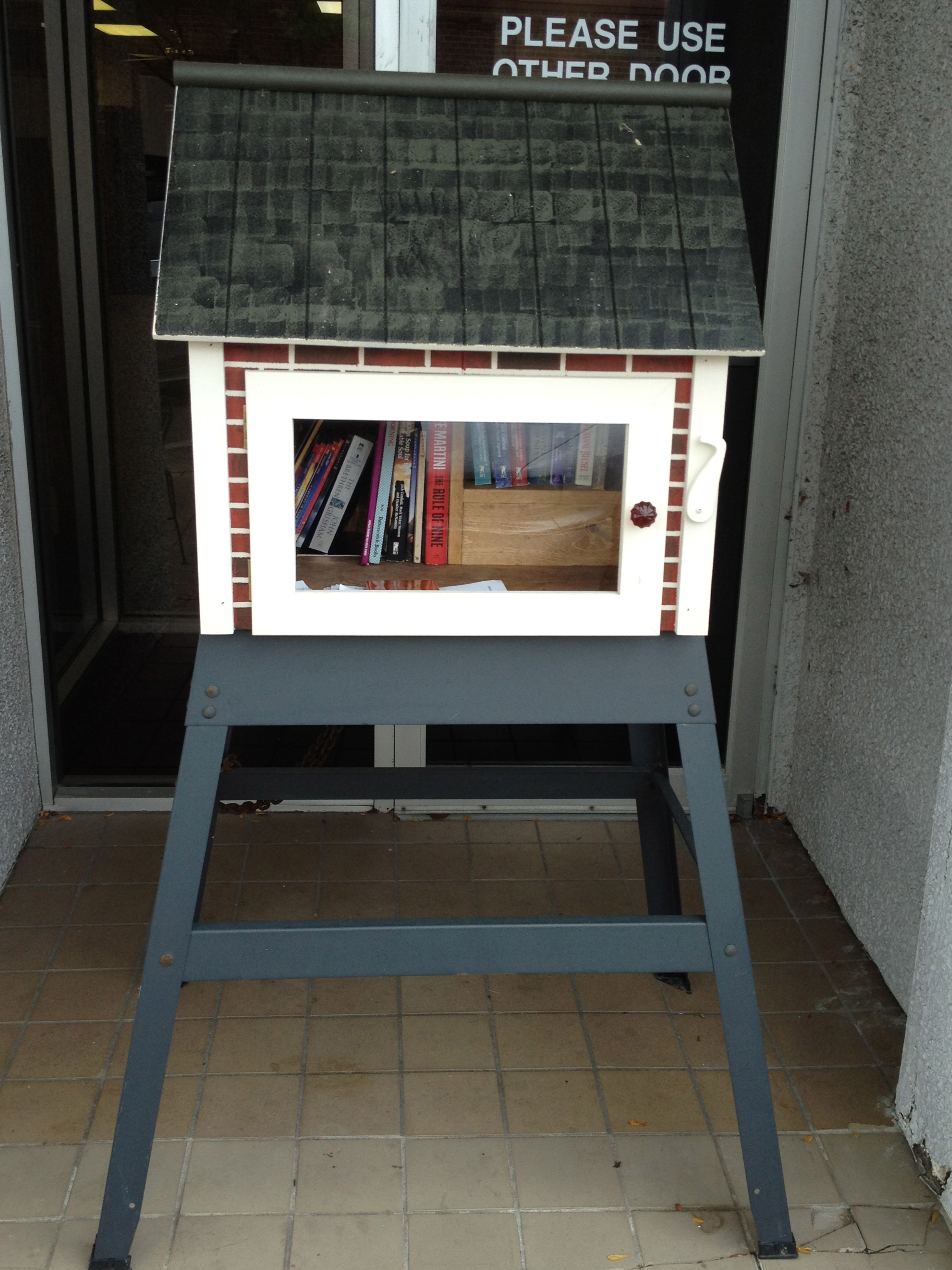
The goal of the movement’s founders is to create over 2510 libraries.  Since this was the first such library I have encountered, I assume the movement is far from reaching its goal.  But with the support of America’s Community Bank, there is now also a second tiny library in Blue Springs.  Hopefully more are on the way. The owners of the Brownfield House, excited by my excitement, told me about their interest in the project and directed me to this tiny library in front of the bank building.

Do you want to be the first in your neighborhood to provide a library?  No staff, no employment taxes, no payroll.  All it takes is a little creativity and the best books to share with others–your own.

Happy reading!

David Brownfield: He Lived Through 89 Years of Blue Springs’ History

David R. Brownfield, Sr. was born December 18, 1922, to Wade Brownfield and Margaret Dillingham Brownfield.  He died September 13, 2012. He was the son and grandson of pioneers who settled in Eastern Jackson County, Missouri.  He was devoted to his family and his community.  He was a good man.

His funeral was yesterday.  The funeral was held only a block from his childhood home.

His home, the “Brownfield House” is a historic landmark in Blue Springs. It sits next door to his grandparents’ home, which became, fittingly, the “Dillingham

Museum”. The homes are located at 15th and Main Street.  They are in the heart of the Blue Springs Historic District.  In fact, they appear to “be” the historic district.

The portrait of his mother, Margaret Dillingham, is a prominent feature of the museum. Often, people who are born, live and die in one relatively small town live lives with a minimum of adventure.  But nothing could be further from the reality of David’s life.

David served in the United States Navy during World War II.  He was trained at Cornell University before being given his orders to serve in the Pacific Theatre.  His assignment was to build runways for U.S. military planes that were moving through the Pacific after Pearl Harbor, often in advance of U.S. troops.

On his return from the war he went to work for AT&T , where he built his career.  He was assigned to Alaska, where he helped build Alaska’s telephone infrastructure. Separated from his family, he nonetheless loved his experiences in what was in the 1950’s truly a wilderness.

He returned home where he remained an AT&T employee for the remainder of his career. On his retirement, he became an active member of the “Pioneers”, a service organization for long time Bell System retirees. In the midst of this he married twice, each of his wives preceded in him death. He raised a family and was an extraordinary influence in the lives of his grandchildren, including Jake Hodge, Meg’s husband.

When Meg and Jake began dating, David immediately won her heart by faithfully attending the annual performances of the Messiah, performed by the Independence Messiah Choir.  (Those faithful to our blog are aware that Meg sang in the choir before graduating from law school and moving to California.)  Meg and David developed a special bond, focused, I am sure, on their mutual affection for Jake.

When Jake spoke at his grandfather’s funeral, he focused on his love and deep connection to him.  He talked about David as a role model. He talked about his grandfather’s wisdom “to put family first”, and quoted from his grandfather that: “If you work hard enough, you can accomplish great things–and even surprise yourself.”  Jake has certainly followed this sage advice, loyal to his family, and working long hours to put himself through the University of Kansas and now succeed in his career.  Jake, Meg and Jake’s family will miss this wonderful man.

David Brownfield was a wonderful representative of what Tom Brokaw has so aptly described as “The Greatest Generation.”  He will be missed.

My DNA–What? Surely you Jest!!

Seriously.  I do a little DNA test and what do I get?   Total confusion.  I mean, seriously, who did I think I was?? Wrong, wrong, wrong.

Based on more than 5 years of research relying on Ancestry.com, google, family records, public records, photographs and other research, I expected my DNA results to look something like this:

British Isles: 60%, Western Europe: 35 %, Other: 5 %.

Ancestry.com even includes on its site a clever little circle graph showing the nature of the information that members would receive about their genetic markers.  It seemed so simple.  Once again, wrong, wrong, wrong.

I expected, and found, strong evidence of family roots in the British Isles.  Mom’s family (Harrises, Bayes and Wrights) and my maternal grandmother’s family, (Lewises), all have strong ancestral ties there.  But where I expected my heritage to be dominated by British and Western European ancestors, instead I now understand I have lots of ancestors from Scandinavian countries.  I had not anticipated a single Swede, Dane or Norwegian in my entire family tree.  My Middle Eastern and Southern European roots–seriously, where do they come from. My anticipated heritage is so different from the heritage established by my DNA.  I am intrigued.

The question I raised in my last post about my DNA test indicated I expected to see some data in the “other” column as a result of the somewhat obscure origins of the Lumbee “tribe” of North Carolina.  My ancestor, Morris Teeter, who was born in 1737 and died in 1812, was buried in the Cummings Cemetery near Pembroke, NC.  Apparently, he was a Lumbee or married to a Lumbee.  If that information is correct, then I certainly have no native American DNA indicators.  Perhaps the rumors that the Lumbee are descended from early sailors to the New World (obviously Scandinavian and maybe Persian) is true.  I don’t know.  I don’t want the Lumbee tribe to take my word for it.  But they may want to be DNA tested themselves. Really.

But I digress–kind of!

Where are the Mesle/Kirsch Western European ancestors?  What about the centuries I expected granddad’s family to have lived in Western Europe before moving from Germany to the United States?  Nowhere.  Absolutely nowhere. I have 5 years invested in learning about the migration of the Mesle name from St. Maixent, France, spreading throughout France and into Germany, Belgium.  5 years trying to determine where in the small world of Mesles my own family had its origins before appearing in the record books in Stuttgart, Germany in the early 1800s.  Now, I do not know whether I am, at all, connected by blood to those Mesles.  Maybe they are, as I once read, descended from Vikings. But could they have lived in Western Europe for 800 years without picking up even a hint of German or French DNA markers?  Of course not.

The question, of course, is “Does it matter?”  If my interest is in tracing the religious, ethical and educational history of my family, it may not matter at all.  If my interest is in my blood line, then maybe the most important message is that none of us may be who we think we are.

Now that, is something to chew on!

Another exciting Kansas City weekend

Jake and I went home for the holiday weekend for several reasons. We had a wedding, a few family members who needed some extra love, and naturally we needed some good KC barbecue. While my work life is about to get crazy, it was a perfectly timed trip.

We have now learned that in order to see everyone over these weekends we simply have to split up and do the best we can. It can be exhausting, but oh so wonderful to spend time with our family and friends he in KC. I even managed to have a few afternoons of bonding time with my parents, including a yummy dinner at the new Mexican restaurant on the plaza with Pud.

Friday night was Brian and Tracey’s wedding. Mum was the officiant, and she did an amazing job of making everyone laugh and feel excited about being inside in light of all the rain. Tracey looked stunning of course!

Padre and I were able to fit in a 125 mile ride on Sunday morning, stopping at a little diner outside of Perry, KS for some breakfast. I ride a 2002 V-Rod, and Padre rides a 2009 Softail.

On our last morning of the trip, I went for a refreshing run and passed by Nicholas Kemper in Loose Park. Little did I know that Lotte was in town too! After my Mum’s delicious French toast, we went to meet the Kempers for a latte at the Roasterie. It was the perfect end to a wonderful weekend in Kansas City.