Vietnam: Honoring Our Veterans

Today is Veteran’s Day.  For most of us it represents a holiday: a day without the responsibilities of work, a day to spend with family or friends.  But it is, really, so much more.  In a time when our nation is at war in Afghanistan, and when our soldiers are being killed in action, or returning home with serious physical and mental injuries, it is important to honor their service.  We must also respect the sacrifices they have made for us and to always, always remember the human cost of our countries decision to go to war.  As a result, Veteran’s Day is, and should remain, a day of reflection, a day of sadness and a day of loss.

 The memories of each war are different.  The few remaining veterans of World War II have a different experience than those of the Gulf War, the Korean War and every other war of our time.  To fully understand Veteran’s Day you must, almost necessarily, have served in the military or been close to someone who has served.

Kansas City’s Vietnam War Memorial, located at 43rd and Baltimore, is dedicated to the men and women who lost their lives in the Vietnam War.  The memorial wall includes the names of 385 Kansas City area servicemen who lost their lives during that war.

This wall is personal to many Kansas City residents.  For me, the name  John Igert says it all.  Johnny was a friend, a classmate and a casualty of the war. He graduated from William Chrisman High School in 1964, and attended Central Missouri State College, in Warrensburg, Mo., before entering the military in 1967.  He died in Gia Dinh, Vietnam, on August 17, 1968, just three months after he should have graduated from college.  He was only 22. He was an easy person to know.  He was fun, he was a good man, though only barely a man when he began his military service–and when he died.

Each of the 385 servicemen whose names are carved in the granite of the monument has a similar story.  Each name represents someone who is remembered by family and friends, who loved him when he was alive, and love him still.  Each name represents a life lost.

Kansas City’s Vietnam War Memorial honors our soldiers who fought, died and missing in action.  The memorial acknowledges that the war deeply divided our country and that in the middle of the dispute were the men and women who fought and died in the war.

The memorial is based on a series of pools and fountains.  The separation of the pools is designed to acknowledge the deep divisions within the country over the war. The fountains represent the healing and cleansing power of water in restoring our national spirit.

The words on the granite summarize a message of hope.  “Only by remembering can we assure it never happens again”.  Wishful thinking?  Repeatedly.  But the message of hope sustains us and causes us to search for better solutions to the challenges of our times.

Have You Voted?

Have you voted.  I have!  I feel really good about it.  I smiled at all of the other early voters as though we have a special bond.  We do.  Whether we agree on all of the candidates, we all understand the importance of voting as an essential element in our Constitutional rights and freedoms.  Our respect as voters for our nation and our democracy ties us more closely together than any of our differences.

If you haven’t voted yet, take the time to do so now.  You will feel better for having done so.  Then wear your “I Voted” stickers as a reminder to your family and friends to vote.  And don’t forget, at the end of the day we are all in this together.

Women’s Suffrage And The Importance of Voting

Because we are on the eve of a national election, I think it is important to remind ourselves, as women, of the sacrifices made by earlier women who worked and sacrificed to secure this basic right for women–the right to vote.

My grandmother, Mary Lewis, was an early feminist and suffragist.  My grandfather, Frank Mesle, being a wise man, wooed her by respecting her beliefs and making them his own.  One of his early letters to her in 1910 included the following quote from an unknown source:  “When the husband gets ready to regard his wife as an equal partner…when he will grant her the same privileges he demands for himself; when he is willing to allow his wife to liver her own life in her own way without trying to ‘boss’ her, we shall have more true marriages, happier homes and higher civilizations.”

It was ten years later, when my own mother was one years old, that women gained the right to vote.  I was born a mere 26 years later.  Not a very long period of time in the history of this country.  But worlds apart in our understanding and expectations of women’s role in society.

Until the  mid to late 1900’s, women were, in many significant respects, under the legal control of husbands and fathers from birth to death, without the right to own property, vote or participate meaningfully in business or government.  The obstacles to equality for women are nowhere better illustrated than in the Supreme Court’s 1873 decision in Bradwell v. Illinois. [1]

Born in 1831, Myra  Bradwell’s husband was a successful lawyer, judge and member of the Illinois General Assembly.  Myra was a teacher, respected citizen and active in the community.  She founded a legal newspaper and supported women’s suffrage reforms, in addition to  engaging in a wide variety of other activities of no small import. She undertook legal training with the hope of being admitted to the Bar of Illinois.  Her application for a license to practice law was rejected by the Illinois State Supreme Court because, as a married woman, she could not enter into any legal contracts–a basic requirement of practicing law [2].  Ultimately Bradwell appealed to the U.S. Supreme Court claiming a violation of the 14th Amendment.  In writing the decision adopted by the  Supreme Court, in language feminists can quote to this day, Justice Joseph Bradley wrote: “The natural and proper timidity and delicacy which belongs to the female sex evidently unfits it for many occupations of civil life…[T]he paramount destiny and mission of woman are to fulfill the noble and benign offices of wife and mother. This is the law of the creator.”

Undeterred by the Supreme Court’s ruling, and presumably rejecting the notion that  God believed women should be so limited, feminists continued to press for Constitutional protections, primarily focused on the right to vote.  Susan B. Anthony, Elizabeth Cady Stanton and others, dedicated their lives to the struggle for women’s rights: woman’s suffrage, the right of women to own property, retain their own earnings, and to have access to academic opportunities.  From as early as the 1850’s, Anthony and Stanton traveled throughout the United States and Europe in support of women’s rights.  On July 4, 1876, in Philadelphia, Anthony presented on behalf of the National Woman Suffrage Association the  Declaration of  Rights of Women of the United States [3]. Her lengthy speech, while compelling, [4] is particularly powerful concerning the denial of a woman’s right to vote:  “ Universal manhood suffrage, by establishing an aristocracy of sex, imposes upon the women of this nation a more absolute and cruel depotism than monarch; in that, woman finds a political master in her father, husband, brother, son….”  Stanton died in 1906, 14 years before her vision of universal women’s suffrage became a reality.  In 1979, in honor of her role in the struggle for women’s rights, the U.S. Mint issued a dollar coin with her image.

The final struggles and success of the so-called suffrage movement is well described in the powerful movie, Iron Jawed Angels[5].  This movie focuses on the period immediately leading up to the passage of the 19th Amendment. It tells the story of the relentlessness of women leaders like Alice Paul and Lucy Burns, who through the early years of World War I fought tirelessly to persuade President Woodrow Wilson to endorse their right to vote.

As the U.S. was entering World War I, some 35 years after the Bradwell decision, suffragists began to picket of the White House.  Their theme was questioning why we should be fighting a war abroad in defense of Democracy when women at home did not experience Democracy.

Despite romantic descriptions of women’s delicacy and timidity, women engaged in the feminist movement behaved, and were treated, without regard to any such perceptions. Their leaders were fined and then imprisoned for 60 days for “obstructing traffic”. They continued to picket.  Alice was sentenced to 7 months in prison.  She was ultimately placed in a solitary confinement and began a hunger strike. Attempts were made to have Alice declared insane. [6] Ultimately she was  force fed by her jailers, who repeatedly fed her through a tube down her throat.  Denied access to the public, their families and even lawyers, it was the husband of one of the leaders of the movement who ultimately advised the press of the treatment of these women.

Learning of the treatment of the suffragists, on January 9, 1918, President Wilson reversed his opposition to women’s right to vote. He urged  Congress to vote in favor of a Constitutional Amendment guaranteeing women’s right, stating:  “we have made partners of the women in this war…Shall we admit them only to a partnership of suffering and sacrifice and toil and not to a partnership of privilege and right?”

On June 4, 1919, the U.S. Senate passed the Nineteenth Amendment, guaranteeing the right to vote, by one vote.  On August 26, 1920, Tennessee became the 36th state to ratify the amendment.  The Amendment became law.

The sacrifices of women like Alice Paul were life changing. Without her bull-headed resistance to the status quo, women’s suffrage may well have been delayed for years.  Her sacrifices and the sacrifices of women before her, secured the beginnings of real change for women’s status as full members of society.

It is important that all women honor and acknowledge the sacrifices from the past.  Please vote on November 6, and every election.  Vote for the candidates of your choice, but vote.

[1] Bradwell v. Illinois, 83 U.S. (16 Wall.) 130 (1873).

[2] It is not to be ignored that she was denied a license because legislatures controlled by men denied her, and all women, basic rights to own property, enters contracts, keep their own earnings and otherwise control their own destinies.

[3] The original Declaration of the Rights of woman and the Female Citizen was written by Olympe de Gouges a French patriot, in 1791.  It is modeled on the Declaration of the Rights of Man and of the Citizen, adopted in 1789 by the National Constituent Assembly during the French Revolution.

[4]  This speech also includes a quote from Abigail Adams, who said: “We will not hold ourselves bound to obey laws in which we have no voice or representation”.

[5]  Released in 2004, the movie starred Hillary Swank.

[6]  Historically,  male doctor, refused to find her insane, stating that bravery in women has sometimes been mistaken for insanity.

________________

The views presented in our blog do not represent the positions of our families, our friends or our employers.

Justice In Our Courts: A Fair And Impartial Judiciary

The U.S. Constitution provides for a separation of executive, legislative and judicial powers. [1]  The role of the judiciary is unique among the branches of government.  Our courts are accountable to the United States Constitution, federal and state laws, and the constitutions of the individual States.  Most citizens are in agreement that they want judges to be accountable to the law and not to special interest groups.

In 1940, in response to the increased role of politics in the selection of judges, the voters of Missouri amended the Missouri Constitution when they enacted the “Nonpartisan Selection of Judges Court Plan”.  Identified as the Missouri Plan, it has, since that time, served as a model for 34 other states.  Now that plan is challenged in Missouri by a proposed constitutional amendment that would significantly expand the role of politics in the selection of state appellate and supreme court judges.

The current “Missouri Plan” provides for the selection of state supreme court and appellate judges utilizing a non-partisan commission whose role is to review and evaluate candidates for judicial vacancies and to present the Governor with a panel of 3 candidates for a judicial position, from which the governor selects the successful candidate.  The 7 member commission is chaired by a Missouri Supreme Court judge [2], and includes 3 attorneys, elected by Missouri attorneys, and three lay members appointed by the Governor.  The lay members and lawyers serve staggered 6 year terms.  The governor selects the lay members. The commission picks 3 candidates for the judicial position.  The governor selects the judge from the 3 candidates.  A sitting governor is able, in a single term, to select only 2 lay members, giving the governor control over fewer than 1/3 of the members of the commission.  Over a period of two terms the governor has control of three appointments, still a minority of the commission.  In recent years the selection process has been modified to provide increased transparency in the selection process by providing the public significantly more information about the candidates.

On the November 6, the voters will be asked to consider Proposition 3, a proposed amendment to Missouri’s Constitution that seeks to expand the role of politics in the selection process.  Inherent in the proposed changes to Missouri’s Non-Partisan Court Plan is increased politicalization of the judiciary. The proposed constitutional amendment would remove the Supreme Court Judge from the commission and give the governor the authority to appoint 4 members of the commission, 2 immediately on taking office and two more 2 years after taking office, thus giving the governor the ability to appoint in excess of 50% of the commission in his/her first term.

There is currently no organized support for this Constitituonal amendment.  Neither Governor Nixon nor his opponent supports the amendment.  What, then, is the problem?  Elected officials who support the Constitutional amendment in Missouri also support the direct election of appellate judges.  Why you say?  Purportedly the proponents are seeking increased accountability of judges.  But to whom?

The Missouri Plan was implemented in response to efforts by political bosses to control the selection of judges, particularly at the appellate levels.  The perception was that these political bosses wanted judges who were loyal to them and not to the law.  This risk can be the same whether the perceived loss of independence results from the dominance of the governor over the selection process or the need of judicial candidates to face elections, particularly in large metropolitan areas where the cost of an election can be significant, thus requiring them to solicit the large sums of money necessary for political campaigns.

The role of our courts is to fairly and impartially enforce the laws and to do so without bias. Experience in states including Texas and Illinois suggests that the  election of appellate judges significantly changes the dynamic of the court system. The challenge associated with requiring judges to solicit significant campaign contributions and to campaign for office includes, almost necessarily, an expectation by donors that judges will have some accountability to them. How can this be a benefit to the fairness of the judicial process?  It can’t.

When you are asked to support changes to the processes by which judges are selected, ask yourself whether you would want to appear before judges who are responsible to the law, or who are indebted to one or more special interest groups.  Hopefully, the answer is quite clear.  Citizens should reasonably expect that judges are fair and impartial, responsible to uphold the Constitution and be governed by it and by other duly enacted federal and state laws, they protect individual rights and that they provide access to the judicial system.  There is no place in these responsibilities for judges who are–or appear to be–subject to the desires of any special interest.[3]

John Johnston, Past President of the Missouri Bar and strong advocate for the retention of the non-partisan court plan summed it up:  “When we select judges, we want people who will be good umpires, not players.  We want people who will set aside any feelings they have about who should or who should not win.  We want people who will apply the rules that we made as a people through our constitution, or that our elected representatives made through laws, or that our governors made through executive policies.  when any of these rules conflict, we want judges who will say that the people win, and that our most direct voice, the constitution, wins.”

Perhaps the Federalist Papers say it the best:  “there is no liberty, if the power of judging be not separated from the legislative and executive powers.” And further: “The complete independence of the courts of justice is clearly essential in a limited Constitution…” [4][5].

Isn’t that what we all want?  I think so.

[1]  U.S. Constitution, Articles I, II and III.

[2]  By tradition, the Chief Justice sits as the chair of the appellate commission.

[3]  Experience suggests that it is in statewide and major metropolitan elections that we face the greatest challenges associated with expensive elections and the associated concerns about contributors attempting to influence judges.

[4] See our post on The Federalist Papers and the Judiciary’s Role in Government, dated Dec. 29, 2011.

[5] See our post on U.S. Role in World Affairs, Pt. 2: Courts as a Model and Trusted Protector of the Rule of Law, dated Nov. 8, 2011.

________________

The opinions expressed in this blog are not the opinions of our employers, our families or our friends.

Cuba: The Cult of Che

Che Guevara was executed in the jungles of Bolivia on October 9, 1967.  Forty five years later he is venerated in Cuba. He has attained something akin to “rock star” status.  His face is on Cuban money, t-shirts, banners, and tourist art.  Billboards with his image encourage the Cuban people to work hard and support the revolution.

Even in the U.S., celebrities wear Che’s signature beret.  He is featured in a movie, The Motorcycle Diaries,whose executive producer, Robert Redford,[1] has depicted Che’s 1952 journey across South America; a journey generally credited with planting the seeds for his future radicalization.

Born Ernesto “Che” Guevara, on May 14, 1928, he was educated as a physician and was already active in social reform when he met Raul and Fidel Castro.  He quickly became Fidel’s 2nd in command and played a key role in the success of the Cuba Revolution against Batista.  He is credited with his work on Cuba’s literacy campaign and its agrarian land reform.  He was a bank president and diplomat for Castro’s government.  He represented Cuba throughout the international community, speaking on behalf of socialism and against the exploitation of the Southern Hemisphere by Western countries.  Ultimately, he  became critical of the Soviet Union, also condemning it for exploiting Cuba.

Celebrated by many as an idealist, he was a lifelong, and very charismatic, revolutionary.  While revered by many for his struggle to liberate the poor, focused primarily in Africa and South and Central America, he is reviled as a guerilla leader ruthless in his discipline of his troops and brutal as the revolution’s chief executioner, instrumental in the war trials and summary executions of Castro’s adversaries.

The nature of his relationship with the Castros at the time of his death is unclear.  On October 3, 1965, two years before Che’s death, Castro made public a letter from Che resigning his positions with the Cuban government, and giving up his Cuban citizenship. Whether his actions result from disagreements with Castro or merely a belief that he should be engaged in a wider campaign of “social justice” is unclear. He returned to Cuba only briefly after authoring that letter. His death changed a questionable relationship to martyrdom.

Che and twenty-nine comrades who fought with him in Bolivia are buried in the Che Guevara Mausoleum.  It is located outside Villa Clara, Cuba, near one of his most significant military campaigns.  It is treated as a shrine, almost a place of worship.  Cameras are forbidden inside the Mausoleum, hats were required to be removed.

Nelson Mandela described Che as “an inspiration for every human being of our era who loves Freedom”.  Jean Paul Sartre described him as “the most complete human being of our age.”  Surely, Cuban exiles living in the U.S., whose family members were executed by Che’s firing squads, find no humanity in his deeds.

Such totally different images of a human being long dead seem incapable of reconciliation. For purposes of this post, I will not try.  Instead, the question may be whether those who exalt him as a hero are influenced to do good or ill. And, from an entirely different perspective, whether his veneration impacts the nature of the short-term–and mid-term–relationships between the United States and Cuba.

________

[1] Robert Redford is photographed with Fidel Castro on the wall of the National Hotel, one of the few luxury hotels in Habana, presumably taken during a brief encounter between the two men during Redford’s trip to Cuba for a private screening of The Motorcycle Diaries for Che’s widow and children.

The opinions of this post do not reflect the views of our employers, our families or–necessarily–each other.

Ben

Benjamin Franklin is one of our nation’s most beloved and celebrated founder. Truly a leader of men, he was a diplomat to France, author of the original Poor Richard’s Almanack, authored portions of the Declaration of Independence and was a delegate to the Constitutional Convention. And that is just the beginning of his talents and accomplishments.

Noted for both his eloquent descriptions of life and government, he could be witty, pithy and wise.  This wonderful sculpture of Franklin, created by George Lundeen, [1] sits by Latte Land on the Country Club Plaza.  Feel free to sit with him for a while.  There is plenty of room on the bench.

                                                   Where liberty dwells, there is my country [2]

[1]George Lundeen sculpted this wonderful bronze statue of Benjamin Franklin.  It is a warm representation of Franklin, one of a series of similar sculptures, large and small.  Lundeen’s creations include national heroes, child athletes, newspaper boys, Native Americans and others are charming and seem to capture the spirit of our national character.

[2] Widely attributed to Benjamin Franklin

Warthogs and other zoo experiences

Lions and tigers and bears–that is what zoos are all about. Right?  I had not been to Kansas City’s zoo for years But I charmed my great friend, Denise, into a weekend visit.  We never did see any lions, or tigers or bears.  It was hot outside and they were hiding somewhere cool.  This wonderful leopard was alone worth the visit.  Even as it slept in the shade, we knew we wouldn’t want to meet it in the wild.

Today’s zoo is nothing like the zoo of my childhood.  Once packed into a small area within Swope Park, the zoo has grown to provide an environment for animals and visitors that give us at least some sense of how the animals might actually live in the wild–well, absent the whole process of catching and eating other zoo animals!

Some areas of the zoo property appear to the eye to be in the wilderness.  It is easy to forget we are in the middle of a metropolitan area. The challenge is that it can actually be difficult to find, let alone photograph, the zoo’s inhabitants. The sense of isolation is worth it.

Denise and I bought platinum tickets which allowed us to ride the trains, buses, trams and gondolas without standing in additional lines. The rides themselves became part of the fun.

With many animals we expected to see napping in the shade, we transferred our attention to animals and birds that seemed to thrive in the sun. We had a great time watching the warthogs bath in the muddy stream. Seriously, I have rarely seen animals in greater need of a makeover!  But they were wonderful to watch.

While giving the appearance of open country, the zoo’s exhibits are carefully divided in such a way that the animals are safe from each other.  Often multiple animals and birds were in the same areas.  They happily ignore each other.

There were a wonderfully rich variety of colorful birds throughout the exhibit.  Many were best seen from the gondola.

We will return in cooler weather.  Hopefully we will find an entirely different group of interesting zoo inhabitants to photograph.  I am looking forward to it.

Two Gentlemen of Sonoma

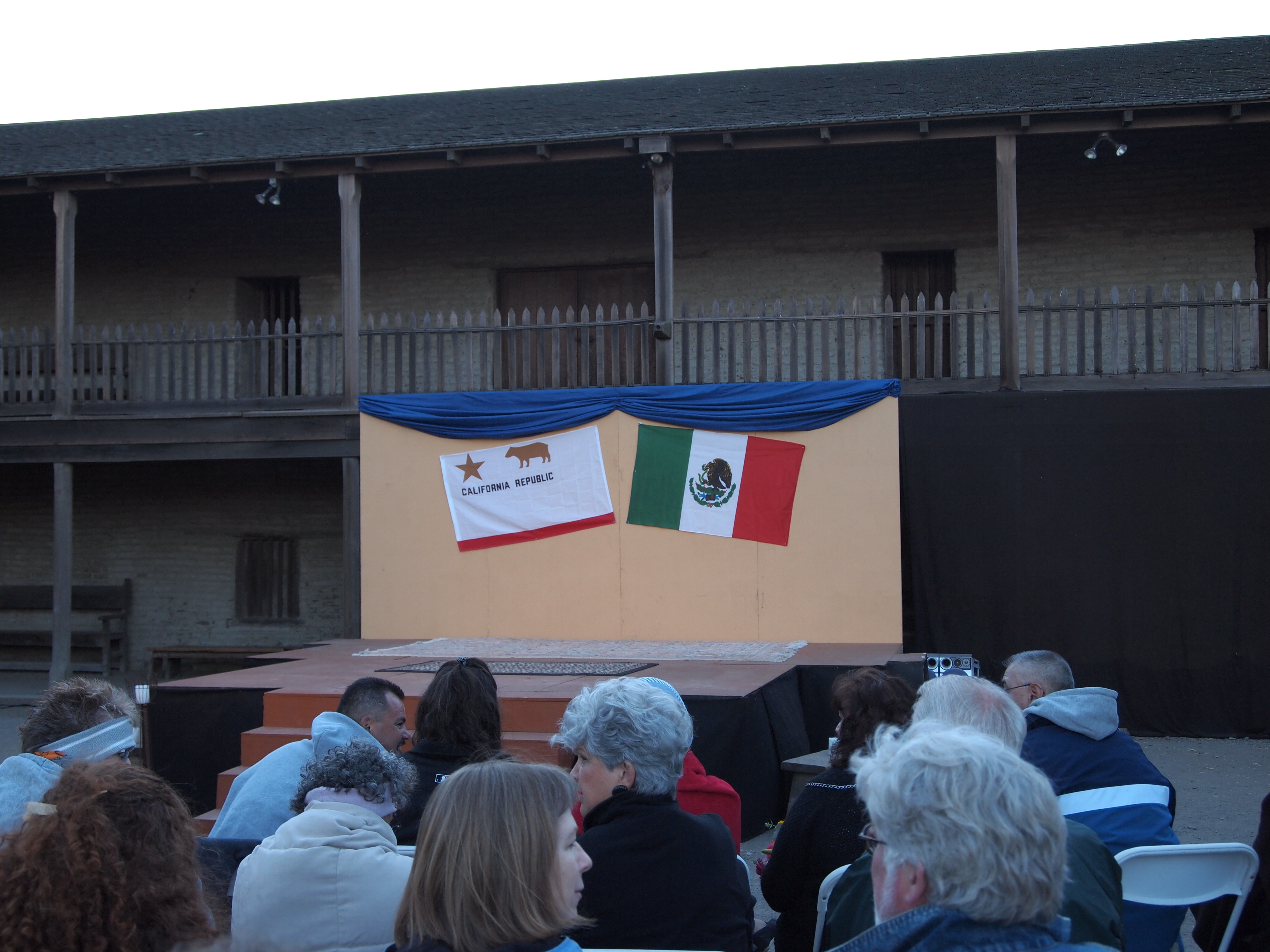
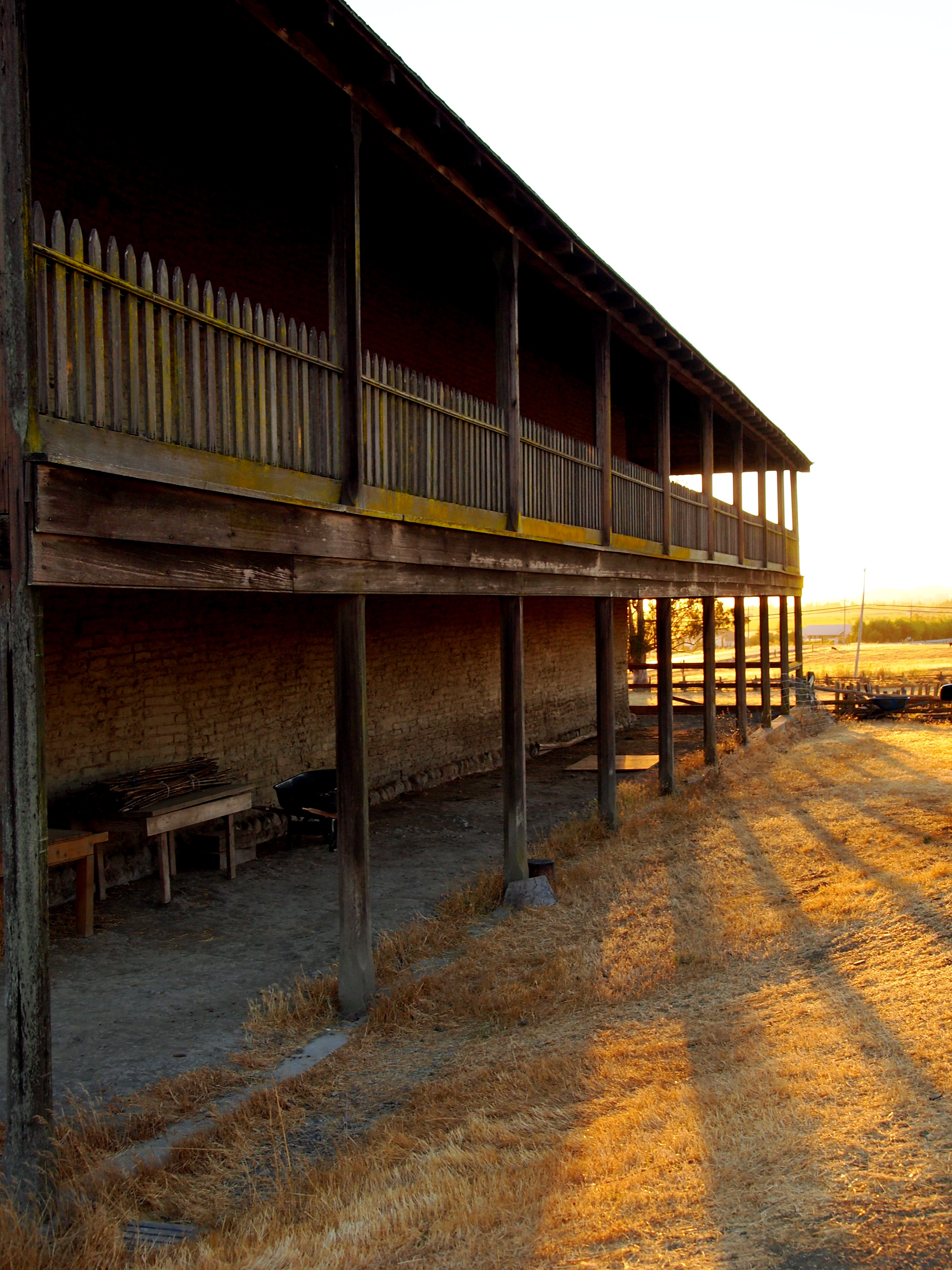
A few weekends back we went to see the play Two Gentlemen of Sonoma (a “play” on Shakespeare’s Two Gentlemen of Verona). Our friends Neal and Maxene were both involved with the production (Neal played General Vallejo, the Duke character, and Maxene was the stage manager). The stage was set for Shakespeare at the Adobe, and it was a beautiful place, just east of Petaluma and set under Sonoma Mountain. We haven’t had a chance to tour it yet, so we were very excited to see the grounds.
The side of the Adobe building was positively beautiful, especially with the setting sun.

We went with our friends, Scott and Katy, and it was such a blast.

There are so many things to see and do here, we never have time to see it all. This gave us a chance to see a little bit of history while enjoying a hilarious piece of artistic expression. This version of Shakespeare’s play was adapted by Director Lucas McClure and it was absolutely wonderful. The show was to benefit the Petaluma Adobe State Historic Park. We will definitely keep this theatre group in mind for future outings!

“The Betrayal of the American Dream” by James B. Steele

The Kansas City Public Library is one of my favorite places.  While it is an incredible building on the outside, it is what happens inside the building that makes it so special. The library provides for Kansas City the kind of educational opportunities I imagine were available in the times of Socrates.  It is a place to read, study and share ideas; not for glory, grades or a degree, but for the sheer love of learning.

Last night’s lecture by James B. Steele, co-author of The Betrayal of the American Dream, presented the library at its best. The  seating areas on the first and second floors of the library were packed. The audience, while diverse by any standard, included a significant number of bankers, academics, reporters, and business and civic leaders of both political parties.  I could barely see Mr. Steele from my seat behind the second floor bannister. Despite the inconvenient seating arrangements, no one left.  The audience listened with rapt attention as Steele spoke for 40 minutes and took questions for another 40 minutes.

Steele is a native of Kansas, and a graduate of UMKC, so he is a “hometown success”.  He began his career with the Kansas City Times before moving to the national arena.  An author and long time investigative journalist, he and his long time collaborator, Donald L. Bartlett have won two Pulitzer Prizes, in addition to other notable awards.  The book, American: What Went wrong?, a No. 1 New York Times bestseller, is one of the seven books earlier books they co-authored.  

Mr. Steele is a gracious and kindly gentleman, but was quite compelling in his description of the current state of U.S. economics and, particularly the destruction of the middle class; the class he identifies as “America’s Greatest asset”.  He describes ways in which he believes that the middle class has been systematically impoverished, forced to respond to long-term job insecurity and loss of income and benefits in favor of the new ruling elite class. 

His lecture moved through the impact of changing lending practices, loss of employment benefits and high levels of student debt as factors in the movement of the middle class to the status of working poor.  He is concerned that because of inadequate retirement resources our older citizens work later in life, leaving fewer job opportunities for those just entering the work force.  Like Malcolm Gladwell in his book Outliers, Steele is troubled by the long-term repercussions on a generation unable to initially find employment at levels consistent with their skills and education.  Those repercussions can include living with parents, delaying marriage, family and home ownership, as well as lowering life-long career and income potential.

Steele does not point the finger at only one political party, but does point out, as others have, that the failure of bipartisanship among government leaders stifles effective problem solving at a national level. He also describes the negative impact of expanded globalization and movement of U.S. jobs overseas where labor is cheap and companies can often work free of regulation.

I do not presume that Mr. Steele has the answer to all of our problems.  He does, however, in a gracious, professional and forthright manner, cause us to reflect on the economic, social and cultural losses we face as a nation and as a community if we continue to move from a country with a strong middle class to a country dominated by a small but increasingly affluent upper class and a large increasingly impoverished lower class.  Food for thought for all of us.

__________________________

This post does not represent the opinions of our family, our friends or our employers.  Hopefully, I have accurately reported Mr. Steele’s views and comments.

Oneida Community–Where Giants Walked

“Where giants walked”.  Those are the words our tour guide, the curator of the Mansion House in Oneida, New York, used to describe the Oneida Community.  Disbanded more than 120 years ago, the community grounds still emit a feeling both vibrant and tranquil.

I didn’t know what to expect when the “cousins trip” arrived in Oneida.  What we found far exceeded even my enthusiastic expectations.  We spent a night in the Mansion House where our rooms were simple but lovely.  The environment was so much more.

The Oneida Community was founded in the belief that individuals can become free from sin while still here on earth.  Beyond their religious aspirations, their practical reality involved a focus on hard community labor, culture, music, art and literature.  These values resonated throughout the community.  Beautification of the grounds of the Mansion House and of the surrounding community are evident today.

While much of the Mansion House is plain, befitting a society based on de-emphasizing private property, there was an emphasis on beauty of the common areas.  The great hall that was a central meeting area demonstrates the community’s commitment to perfection in its culture and art.

The grounds are lovely, incorporating gardens, simple fountains and open areas surrounded by trees.


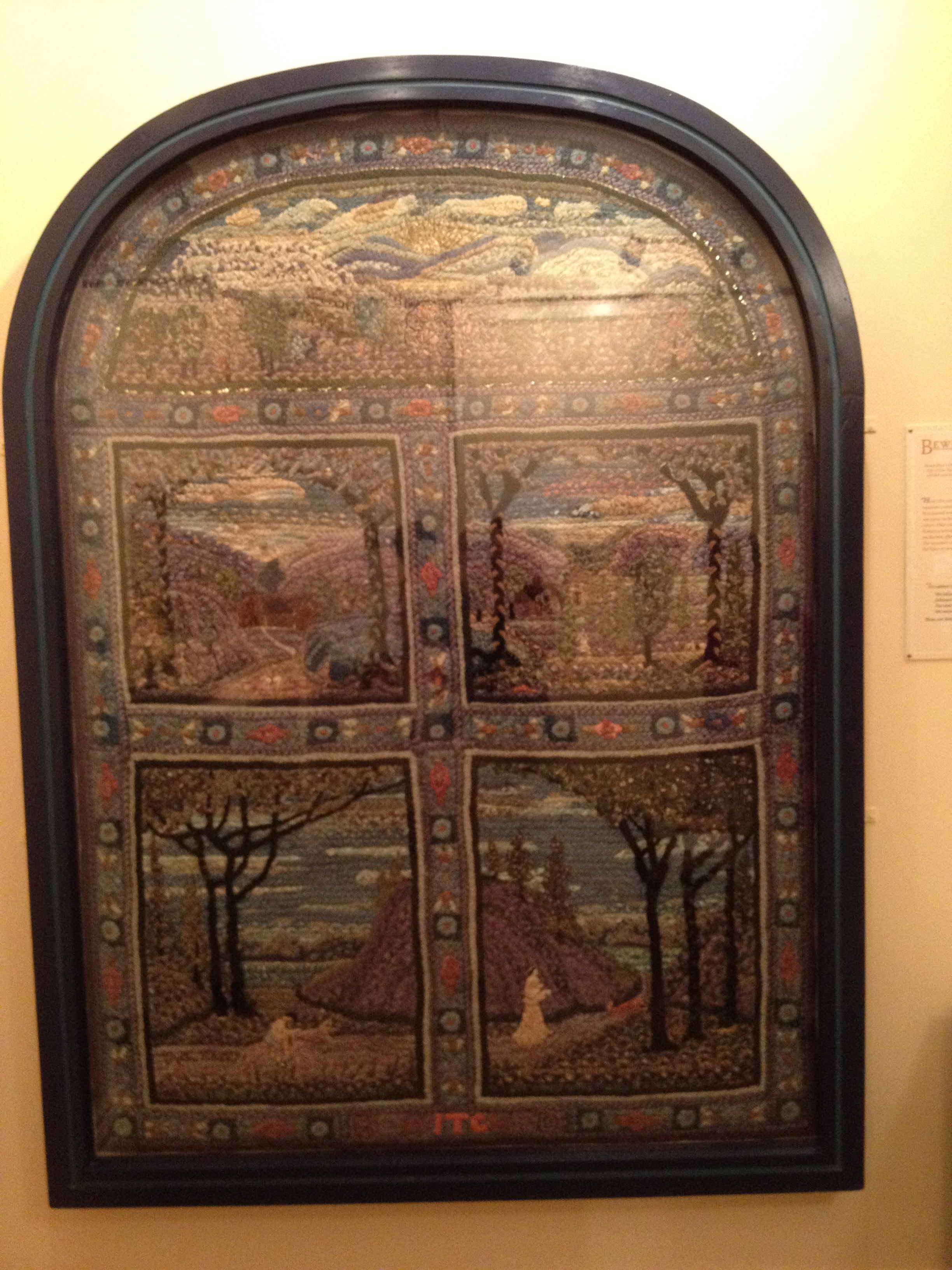
Artistic endeavors were encouraged.  The museum displays beautiful art such as this unique braided rug that are  wonderful works of craftsmanship.

The library was a focal point of daily life, filled with books that were identified as incorporating all of the knowledge important to a learned community.  It remains a great place to visit and study.

While long disbanded as a religious community, descendants of community members continue to live in the shadow of the Mansion House.  While their homes are not elegant, they are as graceful, well-groomed and inviting as the people who live there.

Welcome to “Utopia”.