In Honor of our Readers in India and Tibet

Eastern cultures are so rich with history, religious belief, the arts and education.  As a result of Meg’s posts on Natasha’s wedding ceremonies, we have a fair number of readers from India, the Philippines, Pakistan, Singapore, Bangladesh, Indonesia–the list goes on.  We are grateful for your interest in our  blog.

From time to time we would like to share some of the wealth of art and wisdom that originates from cultures other than ours.

A good friend, born Catholic, has spent a lifetime studying Eastern religions and acquiring art, primarily from India and Tibet.  His collection, primarily of Buddhist sacred and less sacred, carvings, fabrics, and decorative objects, surround you throughout his home.  Because he has attempted to capture the environment of a shrine, he uses dim lights and wraps his statues in beads, strings of light, fabric and other symbols of respect.  I will include posts on our blog that include photographs of his collection.

He is not a wealthy man so he is not competing with museums in his acquisitions. That in no way diminishes the beauty of the art.   The cultures reflected in these works are truly to be treasured:

Buddhist (and Hindu) female deities are generally crowned, serene in demeanor and adorned with beads.

Tibet’s fabrics are often ornate and generally rich with color and design.  Tibet clothing can be quite lovely, with ceremonial clothing full of color, intricate design and elaborate headgear. In the West we are fortunate to see examples as banners, wall hangings and prayer flags. Even such examples give us a sense of the beauty of their design.

While I love the beauty displayed from various works of art.  I am grateful for corrections as I stumble with identifying various deities and ornamental items.  Please feel free to correct me or to provide us with additional information.

We wish you well.

Just Mom and Her iPad Camera

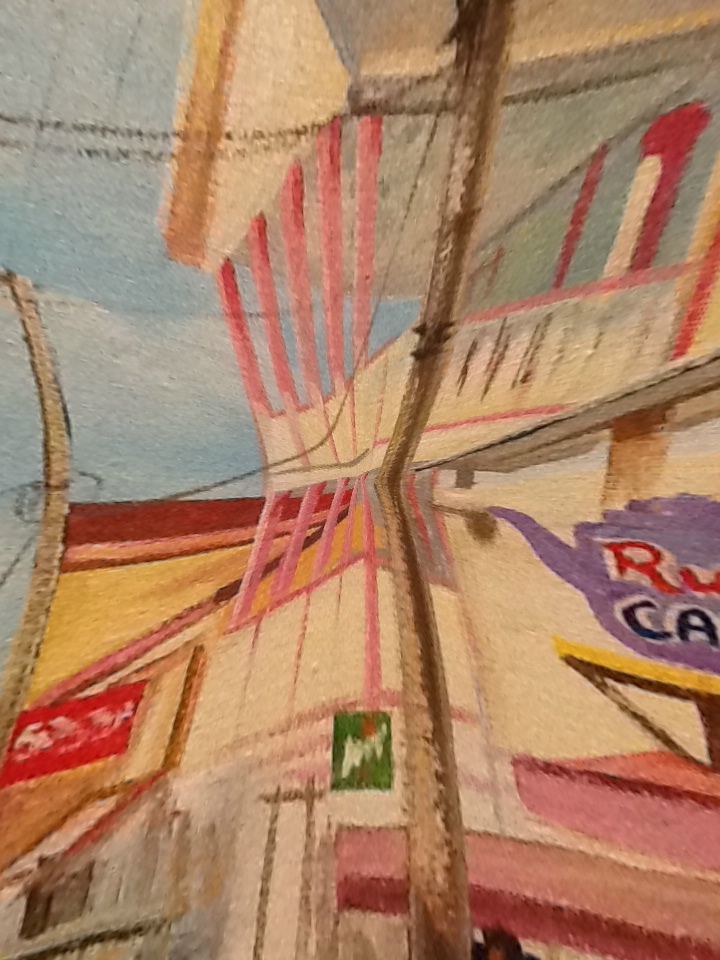
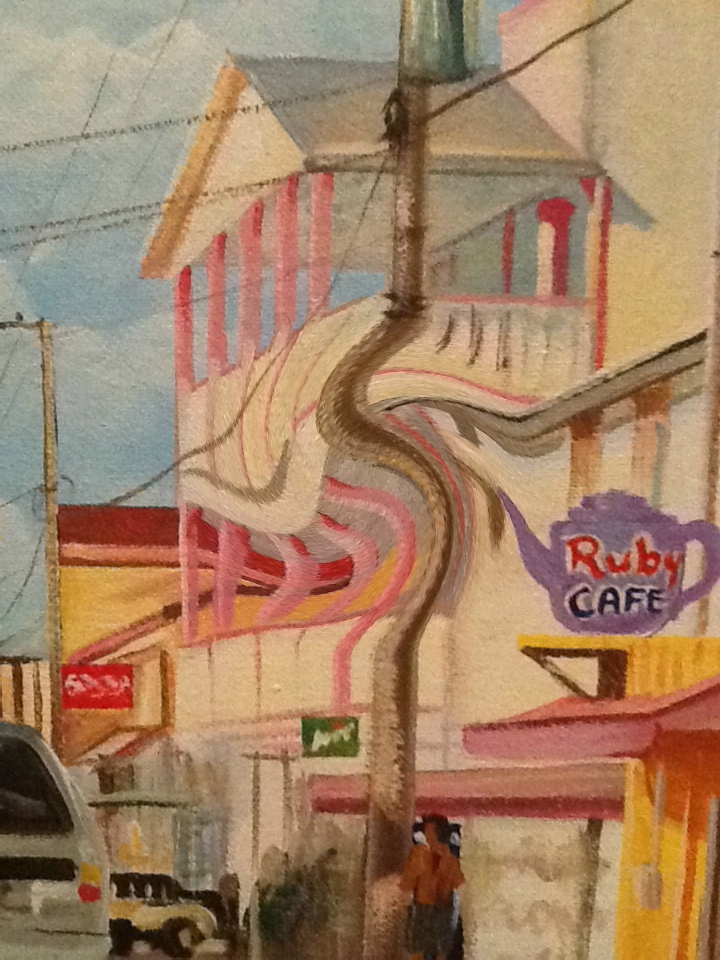
Terry, Meg and I first visited Ambergris Caye, Belize, in October, 2003. It was a marvelous trip.  We stayed at a small condominium complex, “The Palms”, near the center of town.  We so loved our experience that we purchased this wonderful, and inexpensive, oil painting depicting the main street running through town.  It accurately depicts Rubie’s Hotel and Ruby’s Cafe, (yes, different spellings), as well as the surrounding buildings.

Because this painting is vivid and colorful on its own, I decided it was a perfect vehicle for checking out the special effects possibilities on my iPad camera.  Who would think modern technology can create such a variety of images.  All it takes is a willingness to explore the possibilities of “Photo Booth” on your iPad–or your Mac–for that matter.  The special effects options run the gamut from “Squeeze” to “X-Ray”.  For these photographs I chose “Squeeze”, “Twirl”, “Kaleidoscope”, and “Light Tunnel”.  Here are the results:

“Squeeze:

“Twirl”:

“Twirl” again:

“Kaleidoscope”:

“Light Tunnel”:

Aren’t they fun.  If you have a Mac of any sort, give it a try!  Happy Saturday.

The Itsy, Bitsy Spider Grows Up

We all remember the song The Itsy, Bitsy Spider.  While I can’t identify the writer of this classic children’s song, Iza Trapani wrote a children’s book by the same name, all about that spider.

I cannot help but believe that if that itsy, bitsy spider had grown up, it would look much like this spider, a bronze sculpture cast in 1997 by the artist, Louise Bourgeois. It sits on the lawn of the Kemper Museum of Contemporary Art,  a short walk from the Nelson-Atkins Museum of Art in Mid-Town Kansas City.

Behind her, poised on the museum wall, is the “bitsy” version of the Kemper’s Spider.

A Splash of Color

This wonderful wildflower reminded me of the “poor little Buttercup” from the operetta, HMS Pinafore.  I took the photo in Northern California with my iPhone camera.  It was a surprise to me that it was able to clearly capture the detail of the center of the bloom and the foliage behind it, leaving the wonderful golden petals delicately blurred.  Smart iPhone.  Who knew?

Mother nature at her finest!

The Little Free Library–Blue Springs Style

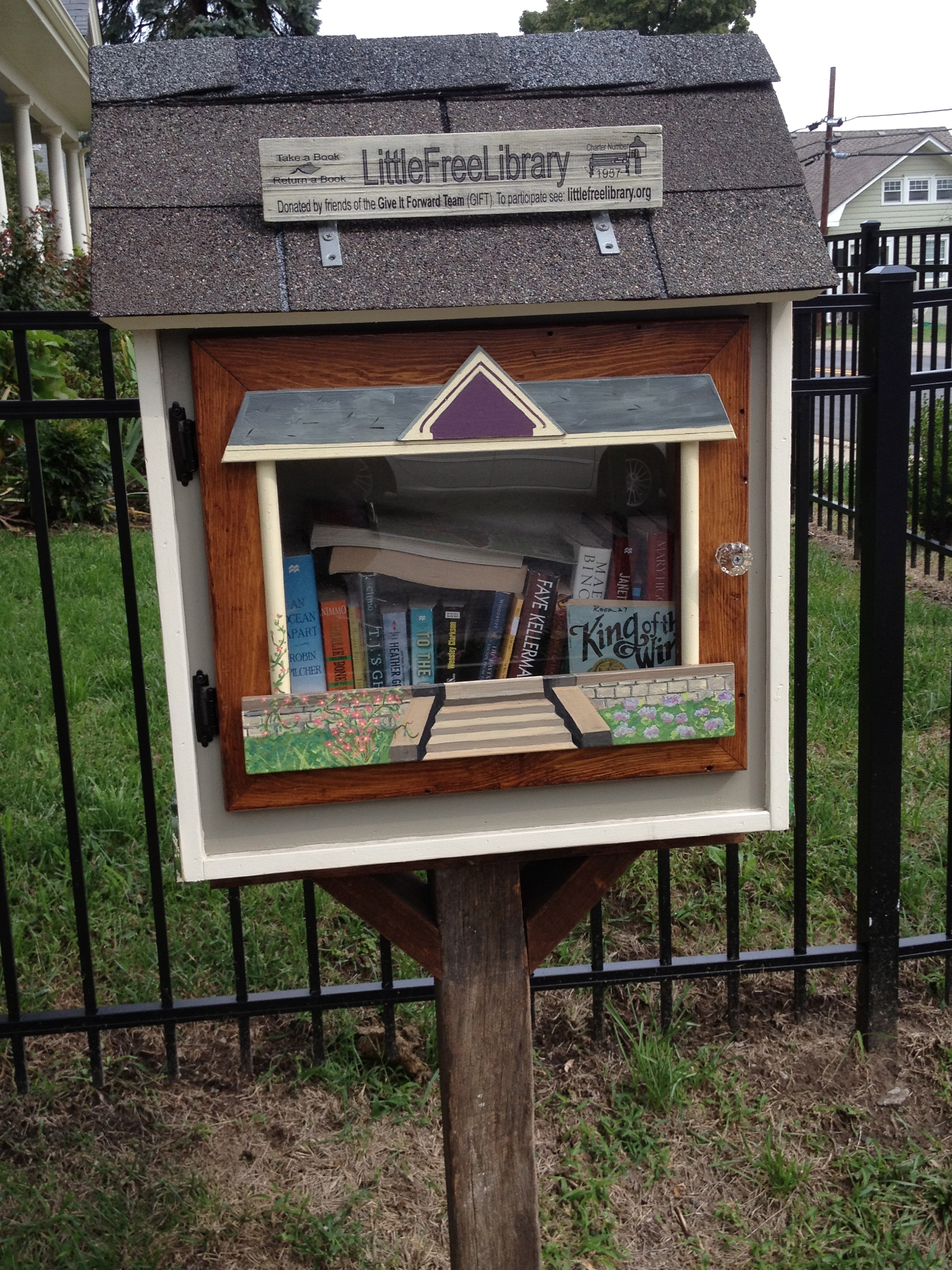
As I was photographing the Brownfield House for yesterday’s post, I saw what appeared to be a slightly oversized bird house.  Fascinated, I aimed my camera for a shot only to see through the viewfinder the words “Little Free Library”.

Last week I first heard about “The Little Free Library”.  It is such an exciting concept.  Begun in Madison, Wisconsin, it has already spread to California and has recently begun making its way into the heartland.

The goal of The Little Free Library project is to encourage businesses and individuals to establish their own tiny libraries to make books easily available throughout the community.  While focused on encouraging literacy and a love of learning, a secondary goal is to encourage healthy and interactive communities.  What is unique about these libraries is their size.  They are tiny, really tiny.  The largest may be redesigned telephone booths.  The smallest aren’t much larger than bird houses.  And they are so cute.

  The way the library works is that containers are placed to be easily accessible to the public.  Neighbors–and strangers–are encouraged to borrow a book, take a book, leave a book or borrow a book at one library and return it at another.

It is truly a “public” library in the best sense of the word.  While the containers have doors of some sort to allow for easy access to take a book or donate a book, and to protect books from the weather, the containers have no locks or keys.  This library simply instructs the observer to “Take One”.  No lecture about rules, due dates, fines or fees.  Just take one.

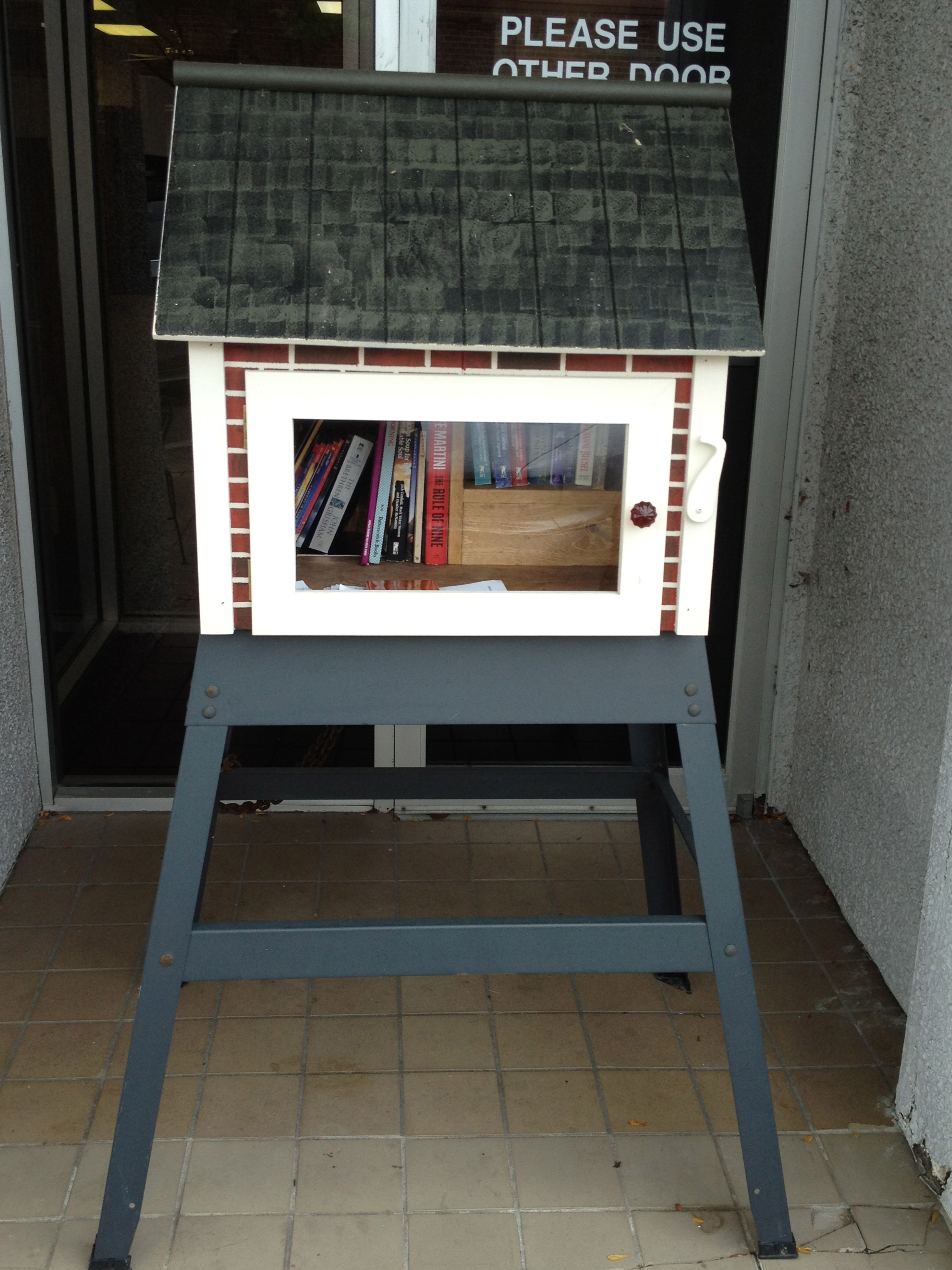
The goal of the movement’s founders is to create over 2510 libraries.  Since this was the first such library I have encountered, I assume the movement is far from reaching its goal.  But with the support of America’s Community Bank, there is now also a second tiny library in Blue Springs.  Hopefully more are on the way. The owners of the Brownfield House, excited by my excitement, told me about their interest in the project and directed me to this tiny library in front of the bank building.

Do you want to be the first in your neighborhood to provide a library?  No staff, no employment taxes, no payroll.  All it takes is a little creativity and the best books to share with others–your own.

Happy reading!

David Brownfield: He Lived Through 89 Years of Blue Springs’ History

David R. Brownfield, Sr. was born December 18, 1922, to Wade Brownfield and Margaret Dillingham Brownfield.  He died September 13, 2012. He was the son and grandson of pioneers who settled in Eastern Jackson County, Missouri.  He was devoted to his family and his community.  He was a good man.

His funeral was yesterday.  The funeral was held only a block from his childhood home.

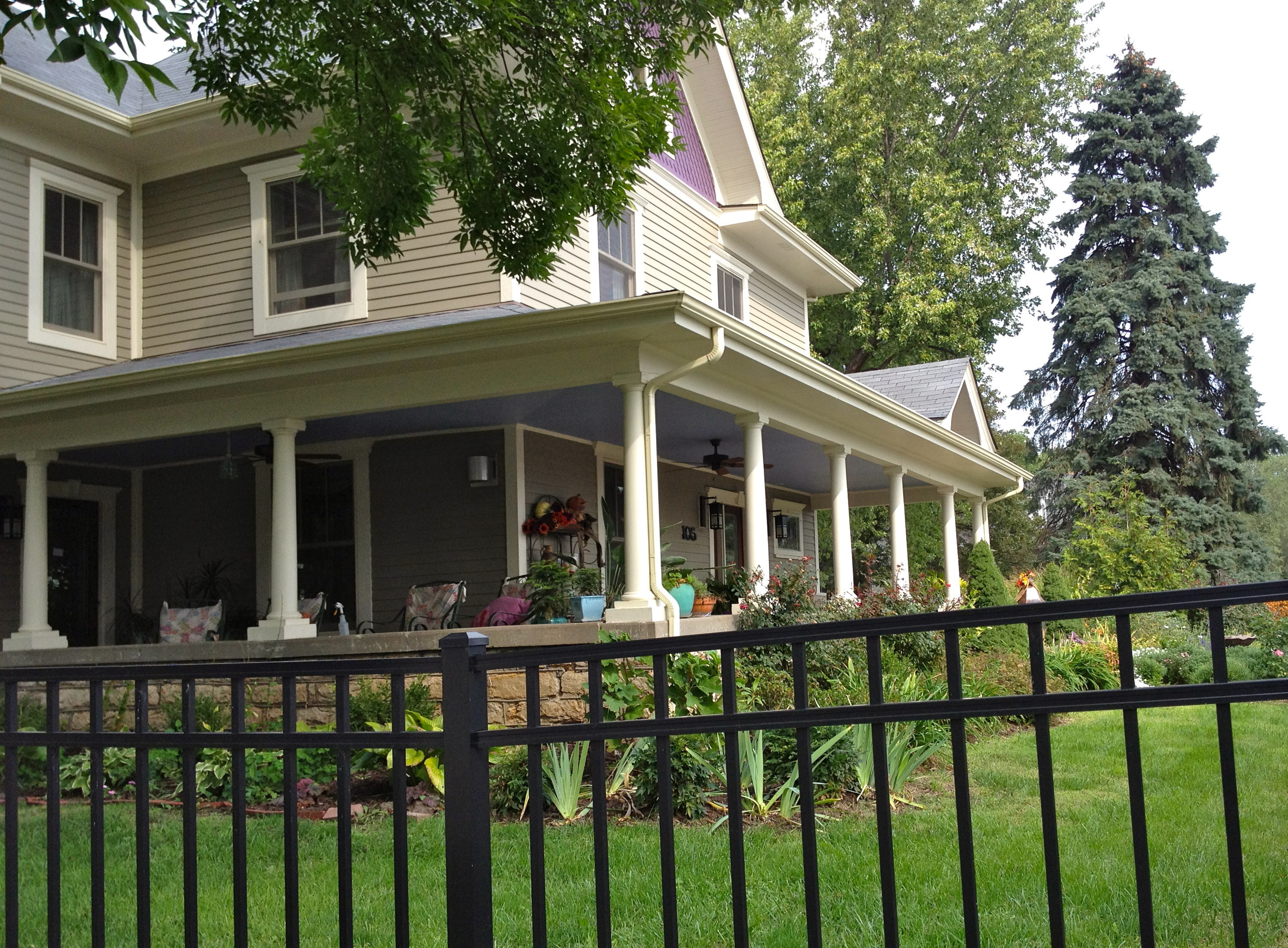
His home, the “Brownfield House” is a historic landmark in Blue Springs. It sits next door to his grandparents’ home, which became, fittingly, the “Dillingham

Museum”. The homes are located at 15th and Main Street.  They are in the heart of the Blue Springs Historic District.  In fact, they appear to “be” the historic district.

The portrait of his mother, Margaret Dillingham, is a prominent feature of the museum. Often, people who are born, live and die in one relatively small town live lives with a minimum of adventure.  But nothing could be further from the reality of David’s life.

David served in the United States Navy during World War II.  He was trained at Cornell University before being given his orders to serve in the Pacific Theatre.  His assignment was to build runways for U.S. military planes that were moving through the Pacific after Pearl Harbor, often in advance of U.S. troops.

On his return from the war he went to work for AT&T , where he built his career.  He was assigned to Alaska, where he helped build Alaska’s telephone infrastructure. Separated from his family, he nonetheless loved his experiences in what was in the 1950’s truly a wilderness.

He returned home where he remained an AT&T employee for the remainder of his career. On his retirement, he became an active member of the “Pioneers”, a service organization for long time Bell System retirees. In the midst of this he married twice, each of his wives preceded in him death. He raised a family and was an extraordinary influence in the lives of his grandchildren, including Jake Hodge, Meg’s husband.

When Meg and Jake began dating, David immediately won her heart by faithfully attending the annual performances of the Messiah, performed by the Independence Messiah Choir.  (Those faithful to our blog are aware that Meg sang in the choir before graduating from law school and moving to California.)  Meg and David developed a special bond, focused, I am sure, on their mutual affection for Jake.

When Jake spoke at his grandfather’s funeral, he focused on his love and deep connection to him.  He talked about David as a role model. He talked about his grandfather’s wisdom “to put family first”, and quoted from his grandfather that: “If you work hard enough, you can accomplish great things–and even surprise yourself.”  Jake has certainly followed this sage advice, loyal to his family, and working long hours to put himself through the University of Kansas and now succeed in his career.  Jake, Meg and Jake’s family will miss this wonderful man.

David Brownfield was a wonderful representative of what Tom Brokaw has so aptly described as “The Greatest Generation.”  He will be missed.

My DNA–What? Surely you Jest!!

Seriously.  I do a little DNA test and what do I get?   Total confusion.  I mean, seriously, who did I think I was?? Wrong, wrong, wrong.

Based on more than 5 years of research relying on Ancestry.com, google, family records, public records, photographs and other research, I expected my DNA results to look something like this:

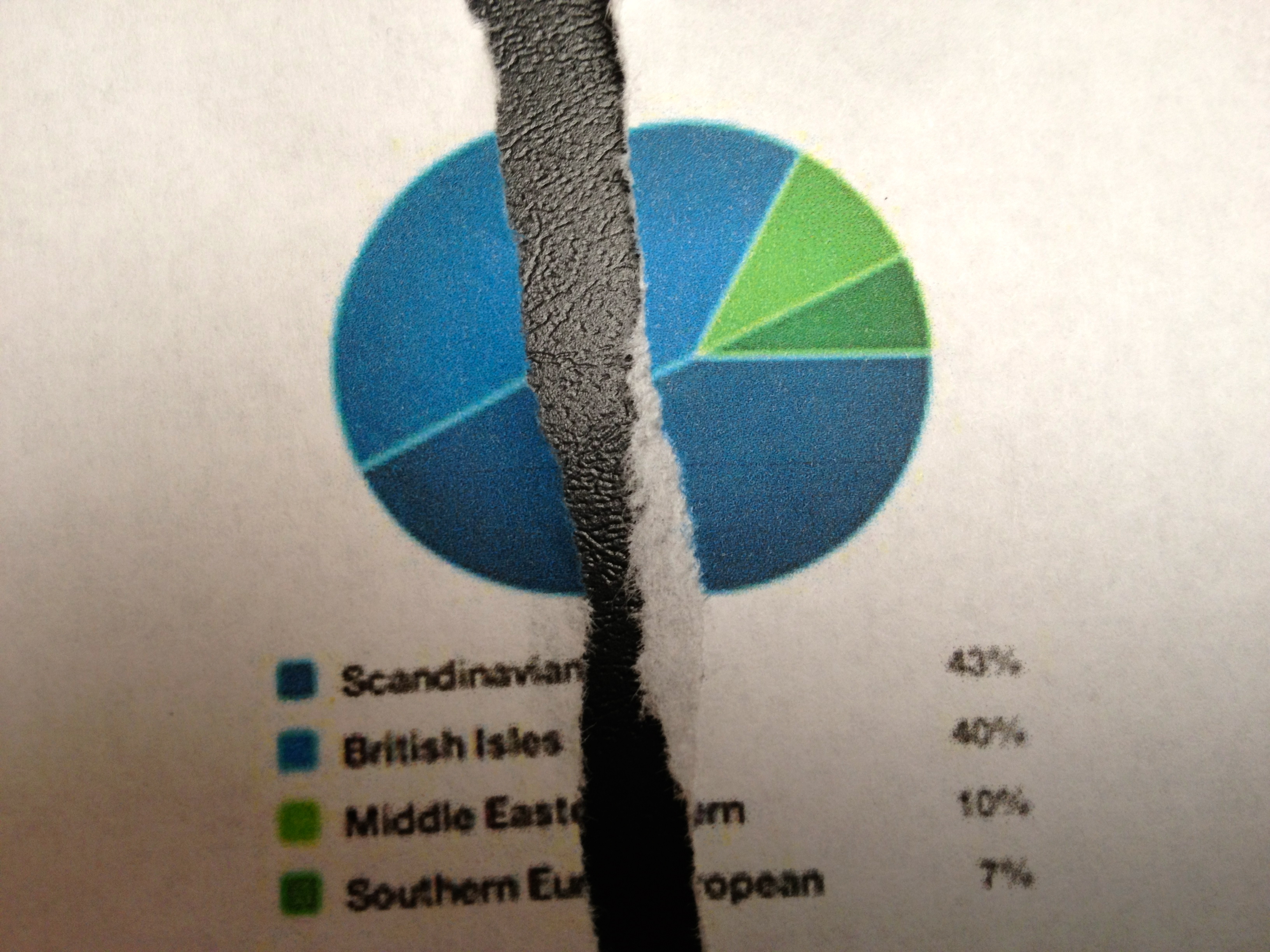
British Isles: 60%, Western Europe: 35 %, Other: 5 %.

Ancestry.com even includes on its site a clever little circle graph showing the nature of the information that members would receive about their genetic markers.  It seemed so simple.  Once again, wrong, wrong, wrong.

I expected, and found, strong evidence of family roots in the British Isles.  Mom’s family (Harrises, Bayes and Wrights) and my maternal grandmother’s family, (Lewises), all have strong ancestral ties there.  But where I expected my heritage to be dominated by British and Western European ancestors, instead I now understand I have lots of ancestors from Scandinavian countries.  I had not anticipated a single Swede, Dane or Norwegian in my entire family tree.  My Middle Eastern and Southern European roots–seriously, where do they come from. My anticipated heritage is so different from the heritage established by my DNA.  I am intrigued.

The question I raised in my last post about my DNA test indicated I expected to see some data in the “other” column as a result of the somewhat obscure origins of the Lumbee “tribe” of North Carolina.  My ancestor, Morris Teeter, who was born in 1737 and died in 1812, was buried in the Cummings Cemetery near Pembroke, NC.  Apparently, he was a Lumbee or married to a Lumbee.  If that information is correct, then I certainly have no native American DNA indicators.  Perhaps the rumors that the Lumbee are descended from early sailors to the New World (obviously Scandinavian and maybe Persian) is true.  I don’t know.  I don’t want the Lumbee tribe to take my word for it.  But they may want to be DNA tested themselves. Really.

But I digress–kind of!

Where are the Mesle/Kirsch Western European ancestors?  What about the centuries I expected granddad’s family to have lived in Western Europe before moving from Germany to the United States?  Nowhere.  Absolutely nowhere. I have 5 years invested in learning about the migration of the Mesle name from St. Maixent, France, spreading throughout France and into Germany, Belgium.  5 years trying to determine where in the small world of Mesles my own family had its origins before appearing in the record books in Stuttgart, Germany in the early 1800s.  Now, I do not know whether I am, at all, connected by blood to those Mesles.  Maybe they are, as I once read, descended from Vikings. But could they have lived in Western Europe for 800 years without picking up even a hint of German or French DNA markers?  Of course not.

The question, of course, is “Does it matter?”  If my interest is in tracing the religious, ethical and educational history of my family, it may not matter at all.  If my interest is in my blood line, then maybe the most important message is that none of us may be who we think we are.

Now that, is something to chew on!

Ben

Benjamin Franklin is one of our nation’s most beloved and celebrated founder. Truly a leader of men, he was a diplomat to France, author of the original Poor Richard’s Almanack, authored portions of the Declaration of Independence and was a delegate to the Constitutional Convention. And that is just the beginning of his talents and accomplishments.

Noted for both his eloquent descriptions of life and government, he could be witty, pithy and wise.  This wonderful sculpture of Franklin, created by George Lundeen, [1] sits by Latte Land on the Country Club Plaza.  Feel free to sit with him for a while.  There is plenty of room on the bench.

                                                   Where liberty dwells, there is my country [2]

[1]George Lundeen sculpted this wonderful bronze statue of Benjamin Franklin.  It is a warm representation of Franklin, one of a series of similar sculptures, large and small.  Lundeen’s creations include national heroes, child athletes, newspaper boys, Native Americans and others are charming and seem to capture the spirit of our national character.

[2] Widely attributed to Benjamin Franklin

Last Days of Summer on Martha’s Vineyard

It is the last days of summer.  Vacations have ended. The summer crowd has left the beaches. I comfort myself with a friend’s reminder that much as we love summer, winter is when things happen.

Still, we already yearn for the return of the lazy days of summer!